
Tracing the story of wine in ancient Pitane, from amphorae to harbours, from the Aegean to the Bakırçay Valley
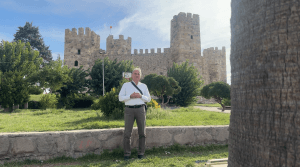
Çandarlı has a magnificent castle that has survived to the present day in remarkably good condition. Sit on one of the benches in the open space in front of it, with the castle behind you, and the Gulf of Çandarlı stretches out before you. Turn your gaze to the right and you see the coastline extending northwards; farther away, beyond sight but not imagination, lie the Aegean islands. And if you could look inland from behind the castle, you would find the Bakırçay Valley and Pergamon .
In antiquity, this was Pitane. One of the cities of Aeolis, Pitane stood on what is now the Çandarlı peninsula, close to where the Bakırçay reaches the sea. Its location made it more than a coastal settlement: it was a natural point of passage between the Aegean and the interior.
If we were to start tracing Pitane’s wine history today, could we discover whether the city has any stories to tell us? That is the trail we will follow in this article.

Was There Wine in Pitane?
Based on what we know today, we cannot say that Pitane was an important centre of wine production. There is no clear reference in ancient texts to the fame of Pitane’s wine, nor has a production facility or archaeobotanical evidence directly demonstrating wine production in the city yet been published. But this does not mean that Pitane stood outside the history of wine. Quite the opposite: archaeological finds show that the Aegean world of trade and consumption, of which wine was a part, reached Pitane. We are not the ones saying this. The finds from excavations carried out some seventy years ago are.
Ekrem Akurgal’s Excavations at Pitane
Ekrem Akurgal carried out excavations in the necropolis of Pitane, the city’s burial ground, in 1958–1959 and 1964–1965. The excavations in the necropolis north of the Çandarlı peninsula provided important evidence about the material culture of the settlement, particularly from the Archaic through the Hellenistic periods. Among the grave goods uncovered were numerous ceramic vessels. Some of them are now displayed in the Ekrem Akurgal Ceramic Artefacts Hall of the İzmir Archaeology Museum.
For the history of wine, two finds are particularly noteworthy.
A commercial amphora from Akurgal’s excavations at the Pitane necropolis, inventory number 4332, was produced on Chios and dates to the late 7th or early 6th century BC. Another commercial amphora, inventory number 4333, was produced at Klazomenai and dates to approximately 525–500 BC.
We can therefore identify at least two tangible trade routes in the Archaic period:
Chios → Pitane
Klazomenai (modern-day Urla) → Pitane
The connection with Chios is particularly significant for the history of wine.
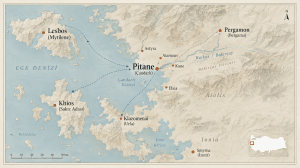
From Chios to Pitane
Chios, the island known in Turkish as Sakız, was one of the ancient world’s production centres renowned for its wine. The discovery of commercial amphorae produced on Chios across a vast area of the Mediterranean and Black Sea provides material evidence of the reach of the island’s wine trade. The presence of a Chian commercial amphora in the Pitane necropolis is therefore significant. Still, we need to respect the limits of the archaeological evidence. The fact that a Chian amphora reached Pitane does not in itself prove that it definitely contained Chian wine, or that the inhabitants of Pitane regularly consumed it. But it does demonstrate one thing clearly:
In the Archaic period, Pitane was part of the Aegean network of commercial circulation.
Ancient drinking vessels such as kylikes found in the necropolis add another dimension to the material evidence for drinking culture at Pitane. Here, wine becomes visible not yet through production, but through circulation and consumption.
Lesbos and Pitane
An important inscription from the Hellenistic period reveals Pitane’s relationship with another Aegean island, Lesbos. According to the inscription, a serious territorial dispute arose between Pitane and Mytilene, the principal city of Lesbos. In this document, dated to the 2nd century BC, the Pergamenes acted as arbitrators between the two cities. The dispute itself went further back, to the Seleucid period. The document shows us that Pitane’s economic geography extended well beyond the Çandarlı peninsula. The people of Pitane possessed substantial lands in the lower Kaikos, the valley we know today as the Bakırçay Valley.
Documents relating to this Hellenistic territorial dispute indicate that Pitane’s hinterland extended towards Atarneus and Astyra and into the Bakırçay plain. This requires us to think about Pitane differently. What we see is not merely a small harbour city, but a city with agricultural lands behind the coast and a position that allowed those lands to be connected to maritime routes. What was grown on those lands is particularly important for our purposes, because this is precisely where a question we cannot yet answer arises:
Were there vineyards in Pitane’s agricultural hinterland?
One of Pergamon’s Routes to the Sea
As Pergamon grew during the Hellenistic period, the economic geography of the lower Bakırçay Valley also changed. Pergamon was not a coastal city. To connect with Aegean and Mediterranean trade, it needed harbours on the coast. Elaia was one of the most important ports in this system; farther north, Pitane also functioned as part of this maritime connection.
Hellenistic commercial amphorae found at Pergamon raise an interesting question. Despite Pergamon’s status as one of the major economic and political centres of the period, the number of imported amphorae found there is lower than might be expected. This has led researchers to consider another possibility: could imported goods have been unloaded at ports such as Elaia, Kane or Pitane and then transferred into other containers for transport inland?
For now, this remains a hypothesis. But given Pitane’s location, it is a compelling one. From the perspective of wine, a possible route begins to emerge:
Aegean → Pitane → Bakırçay → Pergamon
Pitane’s Horizons Expand in the Roman Period
Recent surveys at Pitane suggest that this economic role became more pronounced during the Roman period. Surveys conducted between 2019 and 2021 identified numerous ceramic fragments as well as commercial amphorae originating from different geographical regions. Their origins were not limited to the Aegean; connections with the Black Sea and the Eastern Mediterranean are also evident.
During the same period, Pitane became an important centre of ceramic production. The city is now understood to have been one of the major production centres for the red-slipped tableware known today as Eastern Sigillata C, which was distributed across a wide area from the Aegean to the Black Sea. We are no longer looking merely at a world in which goods arrived at Pitane. Goods produced in Pitane were now travelling out to sea as well.
The Wine History of a Harbour
When we bring all of this evidence together, we can define Pitane’s place in the history of wine somewhat more carefully.
- We do not yet know whether Pitane produced wine of its own.
- Nor can we say that Pitane was a major centre of viticulture.
- But we do know that Pitane was part of the world through which wine circulated.
In the Archaic period, commercial amphorae from production centres such as Chios and Klazomenai reached the city. Drinking vessels have been found in its graves. During the Hellenistic period, Pitane’s agricultural hinterland extended into the Bakırçay Valley, while the city became one of Pergamon’s connections to the sea. By the Roman period, we encounter a centre of production and trade that received amphorae from different regions while sending its own ceramics to distant markets.
For now, therefore, it seems more accurate to understand Pitane’s importance in wine history not as “a famous centre of wine production”, but as part of the network connecting the regions where wine was produced with the markets where it was consumed .
So Where Were the Vineyards?
Perhaps this is the most intriguing question we can ask about Pitane today. We know that the city possessed substantial agricultural lands in the lower Bakırçay Valley. But we do not yet have direct evidence showing how much, if any, of this land was devoted to viticulture.
Archaeobotanical research, new surveys, amphora typologies, clay analyses and epigraphic studies may change this picture in the years ahead. Research in Pitane’s hinterland in particular could provide new evidence for questions about local viticulture and wine production that we cannot answer today. For that reason, it seems more appropriate to end Pitane’s wine story for now with a comma rather than a full stop.
Perhaps a few years from now, standing once again on the shore at Çandarlı, we will ask the same question:
Did Pitane have vineyards of its own?
The answer we can give today is this: We do not know yet. But now we know where to look.