We have travelled quite a distance since setting out from an essay by John Dilworth. In our first article, we asked whether understanding wine and experiencing wine were the same thing. Then, we considered whether two people drinking from the same bottle actually taste the same thing. In the previous article, matters became even more complicated: if our experiences differ, how are we able to reach a shared judgement about what makes a “good wine”?
We ended there with this thought:
We need to ask how much of what we call “good wine” comes from the wine itself, and how much comes from the shared language we have developed to evaluate it.
And we said that we could not answer that question without looking at who created this language and how. That is what this article is about. It also brings our series to a close.
Two People Tasting the Same Wine
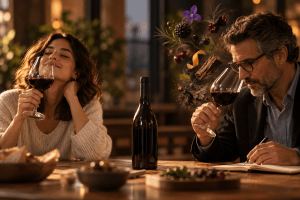
Let us put two glasses on a table at WAYANA. Suppose one of our guests has little experience with wine. They take a sip and say, “That’s very good.”
The person tasting from the other glass is a professional who has spent years immersed in wine. They talk about its acidity, tannins, body, balance, aromatic intensity and the length of its finish.
They both drank the same wine, and they both enjoyed it. But did they taste the same thing? Or, more precisely, did the professional taste more? In the first article in this series, we spoke about two abilities that wine education gives us: distinguishing and naming.
As we become more involved with wine, we begin to notice increasingly subtle sensory differences. As the number of wines we taste grows, so does the number of examples stored in our memory for comparison. We begin to distinguish individual elements within what we once perceived as a single whole.
But we learn something else as well: how to classify what we notice and how to name it. And this brings us to an important threshold:
Learning to notice a characteristic and learning that this characteristic is important. Are they the same thing?
When We Learn Wine, We Also Learn a Language
Wine education does more than train our nose and palate. It also gives us a vocabulary: acidity. Tannin. Body. Intensity. Length. Balance. Complexity. Typicity.
Bu kavramlar sayesinde bir başkasına ne algıladığımızı anlatabiliyor, iki şarabı karşılaştırabiliyor, hatta yıllar önce tattığımız bir şarap hakkında konuşabiliyoruz. Ortak dil olmadan ortak değerlendirme yapmak mümkün olur mu? Elbette olmaz.
But not all the words in this language do the same job. When we say “high acidity”, we are largely trying to describe a characteristic we perceive in the wine, one that can also be measured if we choose to do so.
But what about “balanced”? Or “elegant”? “Complex”? “Typical”?
At this point, we may no longer be simply describing what is present in the wine. We may also be assigning value to that characteristic. Gradually, we move from the question “What do I perceive?” to “Is this good?” So the language of wine does more than allow us to describe what we see and perceive. Sometimes it also teaches us what is worth noticing and how we should evaluate it.
So Who Created This Language?
The language of wine we use today did not emerge one morning because everyone suddenly decided to use the same words. Over centuries, producers, merchants and wine-drinking communities developed their own concepts. In the modern era, wine critics, researchers, sommeliers, educational institutions, competitions and professional tasting systems were added to this process.
As modern methods of sensory evaluation developed in particular, shared concepts, standard tasting conditions and evaluation systems were created to make an apparently highly personal experience comparable. There was a perfectly understandable reason for this. When someone says, “I like this,” it tells another person very little about the wine.
But when we say, “High acidity, medium body, pronounced tannins and a long finish,” we now have something we can compare and communicate to someone else. The shared language of wine was built, at least in part, to make our experiences intelligible to one another.
But we need to be careful here. The fact that something was developed by people does not make it arbitrary. Maps are made by people too. That does not mean cartographers decide where the mountains are.
Nor is the language of wine entirely independent of the wine’s actual characteristics. We do not invent acidity, tannin, alcohol or aromatic intensity in our heads. But which characteristics we pay attention to, the concepts we use to classify them, and how much weight we give them when judging quality may all be learned.
And this is where things become delicate.
Does the Expert Taste More?
There are two easy conclusions we might reach about wine professionals.
The first: “They taste far more than we do.”
The second is the exact opposite: “It is all learned jargon. Everyone is really tasting the same thing.”
Both oversimplify the issue.
Experience and education really do make a difference. Over the years, a professional may have compared hundreds, sometimes thousands, of wines. Their sensory memory contains a much broader repertoire of examples. They may recognise a fault more easily. They can direct their attention to subtle differences more quickly. They can connect a grape variety, region or production method with examples they have encountered before. In short, it is unlikely that all they know is simply more words. They have learned how to look. And precisely because of this, they have also learned what to look for. Their education has taught them not only how to use their senses, but where to direct their attention. Perhaps this is what makes expertise so interesting:
It probably involves both learning to see better and learning what to look for.
We Can Hide the Label, but Not the Language We Have Learned
In the previous article, while discussing blind tasting, we said:
We can hide the bottle, but we cannot hide ourselves.
Now we need to add something else. We can put the bottle inside a bag and conceal the producer’s name, its price, region, even the grape variety from the taster. But we cannot remove from their mind the language of evaluation they have spent years learning. A professional does not enter a blind tasting with only their nose and palate. They bring their education. Their memory. The hundreds of wines they have compared. And the concepts that tell them what to pay attention to.
We can hide the label, but we cannot hide the language we have learned.
This does not make blind tasting worthless. Quite the opposite: it allows us to understand its purpose more accurately. Blind tasting attempts to remove certain biases and external information from the table. But it does not strip the taster of their past or their education. Perhaps it should not. Because that past may be precisely what makes the professional valuable.
So Why Do We Need a Professional?
Everything we have discussed so far could easily lead to a sceptical conclusion. If the language of wine was created by people, if experts are trained within that language, and if standards of quality have themselves developed over time, why should we give a wine professional’s judgement more weight than anyone else’s?
Because learning a shared language does not make expertise worthless. Quite the opposite: expertise is often formed in precisely this way. The value of a good professional lies in more than simply being able to classify a wine faster than the rest of us.
- They have encountered more examples.
- They can make comparisons.
- They can place a characteristic in context.
- They have learned to question their own first impressions.
- They can explain why they think what they think.
And perhaps most importantly, they know that the person sitting opposite them does not have to experience the same thing they do.
This is where one of the important differences between professionalism and authority emerges.
Authority may simply say: “This wine is good.” And leave it at that.
A good professional says: “I think this wine is good for these reasons.” And allows the conversation to continue. The first gives us a conclusion. The second gives us a way to think.
Let Us Return to Our First Question
We began this series with an orchestra conductor. While listening to Beethoven, I wondered whether a conductor who knew the music far better than I did experienced greater enjoyment from it. Then the roles changed. Sitting at WAYANA with the same wine in our glasses, I was now the person who knew more about wine. And I asked myself the same question:
Does knowing more mean enjoying more?
Four articles later, I still cannot simply answer “yes”. But we can now say something else. Knowledge may not necessarily give us greater pleasure. But it may allow us to notice more. We can distinguish things we once perceived as one, name characteristics we previously could not name, and compare our experience with other experiences.
And perhaps that is precisely the purpose of good wine education. Not to teach us what we should like, but to teach us to pay closer attention when we have a glass in front of us. To teach us not to confuse our own perception with the characteristics of the wine, or our personal preference with a judgement of quality.
And, when necessary, to leave enough room to say:
“This is how I experience it.
But it is possible to experience it differently.”
We walked through the door Dilworth opened four articles ago by asking whether analysing wine destroys the experience. Then we saw how the same wine can become a different experience for different people. Despite this, we found that we can form shared judgements of quality, and that we have developed a shared language in order to do so. Now, returning to where we began, perhaps we have a small answer:
The value of knowing more about wine may lie not in telling us what we ought to taste, but in helping us notice more of what is happening in the glass.
And perhaps what makes a good professional valuable is not that they taste on our behalf, but that they help us taste our own glass better.