
Ceremonial Drinking Vessels in Anatolia
Whenever I visit a museum, I feel as though the signals from my senses begin to change. Different emotions intertwine, and my heartbeat quickens slightly. What I find intriguing is that this heightened excitement also brings a sense of tranquillity. I experience something similar when listening to classical music. I felt that same sensation when I encountered an extraordinary object at the Metropolitan Museum of Art in New York. At first glance, it resembled a silver sculpture of a stag, its head and antlers crafted with remarkable skill. Looking more closely, I realised that the animal's body formed part of a vessel. Around its rim, a scene depicting an encounter between humans and gods had been intricately worked into the metal. That encounter, thousands of kilometres from Anatolia, with an object made there some 3,300 years ago, planted the seed for today's article on rhytons.
The first question that comes to mind is this: Why did people choose to drink from vessels shaped like bulls, rams or stags rather than ordinary cups? Did the choice of these animals carry a particular meaning? Where was the liquid inside these vessels poured? And what did any of this have to do with wine?In the journey through Turkey: The World's Largest Open-Air Wine Museum. yolculuğumuzda bu kez antik kentlerin sokaklarından, bağlardan ve şarap işliklerinden ayrılarak müzelerinvitrinlerine uzanıyoruz. İzini süreceğimiz nesneler, Anadolu’nun binlerce yıllık içme ve sunu geleneklerinin en ilginç tanıkları arasında yer alan ritonlar ve hayvan biçimli kaplar.
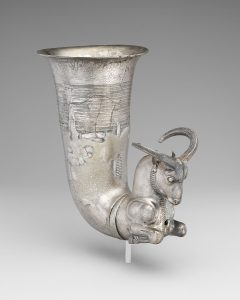
What Is a Rhyton? How Was It Used?
The word rhyton is related to the Ancient Greek verb, rhein, meaning "to flow". In archaeology, it generally refers to a vessel filled through one opening, with liquid flowing out through another. Many of these vessels were shaped like animals. Some had horn-shaped bodies, narrowing towards the head or forequarters of a bull, ram, stag or another animal. Some were made of pottery, others of bronze, silver or gold.
But we need to make an important distinction here: Not every animal-shaped drinking vessel is a rhyton. One of the defining characteristics of a rhyton is an opening in its lower section through which liquid can flow. Other animal-shaped vessels, by contrast, were designed to be drunk from over their upper rims, much like the cups we use today. This distinction is not merely a matter of shape. It is also important when trying to understand how these vessels were used.
Some rhytons were used for liquid offerings, while others served as drinking vessels. We should nevertheless be cautious about assuming that every such vessel belonged to a religious ceremony or necessarily contained wine. It is worth drawing an honest line between what archaeological evidence actually tells us and the interpretations we build upon it.
The collections of the Metropolitan Museum of Art, including the silver stag-shaped vessel I mentioned earlier, offer an excellent starting point for exploring these distinctions. Turkey may be the world's largest open-air museum, but unfortunately, some of its treasures are very far from home.
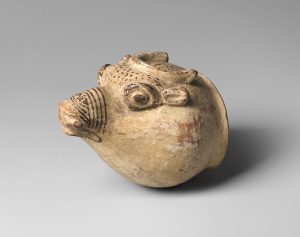
Kültepe: The World of Animal-Shaped Vessels
In the early second millennium BCE, Kültepe, near present-day Kayseri, was one of Anatolia's major trading centres. Known in antiquity as Kanesh, it was a meeting place for Assyrian merchants arriving from Mesopotamia and the local communities of Anatolia. Trade here encouraged the movement not only of goods but also of ideas, techniques and cultural traditions. The pottery vessels discovered during excavations at Kültepe provide striking examples of this cultural diversity. Lions, rams, antelopes, hares, dogs, wild boars and birds... Anatolian potters brought the animal world around them into the forms of their drinking vessels.
One surviving example is a ram-headed vessel in the collection of the Metropolitan Museum of Art, thought to have originated from Kültepe. Dating to approximately 1900–1600 BCE, the vessel was made of pottery. Its light-coloured slip is decorated with details painted in black. The ram's horns, eyes and facial features have been carefully modelled. The Metropolitan Museum's collection notes tell us that animal-shaped vessels of this kind were found at Kültepe not only in religious contexts but also in houses and graves. This suggests that their use cannot be explained solely in terms of religious ceremonies.
But what did they contain?
It is not easy to answer that question with certainty for every vessel. Wine may have been among the liquids used. However, establishing that a particular vessel contained wine requires written evidence, residue analysis or some other indication of its use. For the moment, Kültepe's animal-shaped vessels tell us primarily about drinking practices, pottery craftsmanship and the place of animals in material culture.
When we turn to the Hittite world, another dimension of animal-shaped vessels emerges.
The Hittites: Drinking the God
Studies of the Hittites show that wine was not simply part of everyday life. It also played an important role in religious ceremonies, festivals and offerings to the gods. When we previously examined Hittite laws concerning vineyards and wine, we saw how vineyards and grape products were incorporated into the legal system. This time, we are looking at the religious practices of the same civilisation.
One important term encountered in Hittite ritual texts is BIBRU.The term is associated with drinking vessels made from different materials and produced in various forms. Animal-shaped examples occupy a particularly interesting place in the Hittite religious world. However, BIBRU and rhyton do not mean exactly the same thing.
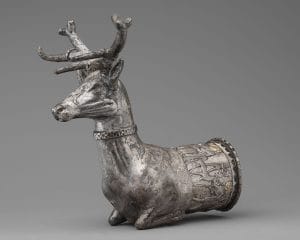
What the Silver Stag Tells Us
The Hittite silver stag vessel in the Metropolitan Museum's collection is one of the most remarkable surviving objects from this world. Dating to the 14th–13th centuries BCE, it was made of silver and decorated with gold inlay. It stands approximately 18 centimetres high. The stag's head, antlers and forequarters have been rendered in extraordinary detail. But what makes the object particularly fascinating is the relief scene encircling the upper rim.
The scene appears to depict a religious ceremony. A liquid offering is thought to be presented from a beaked vessel to a deity represented standing on a stag. There are different interpretations of the scene's details and the vessel's possible function. We are therefore looking at an animal-shaped drinking vessel decorated with a religious ceremony in which another vessel is being used. The scene suggests that drinking and offering vessels were important elements in the relationship between humans and gods in the Hittite world. Yet the ceremony depicted in the relief does not, by itself, prove that the silver stag vessel was used for the same purpose.
There is another interesting feature: the vessel has no pouring hole in its lower section. Consequently, its classification as a rhyton in the strict technical sense remains open to debate. A 2018 study by the Hittitologist Theo van den Hout provides an important basis for evaluating the object's possible function.
Can You Drink a God?
One of the most intriguing expressions found in Hittite ritual texts is commonly translated as "drinking the god". At first, the idea seems rather surprising. How can a person drink a god?
As far as we can tell, the expression refers to ceremonial drinking practices associated with particular deities. However, researchers offer different interpretations of precisely what the expression meant and how the ritual was performed. Some explanations emphasise drinking in honour of a deity, while others focus on the symbolic relationship established with the god through the ritual. It would therefore be misleading to state categorically that the king drank wine in order to achieve a mystical union with the deity.
Nevertheless, when we consider Hittite texts alongside archaeological finds, an important conclusion emerges: In Hittite religious life, drinking was not merely a physical act. It could also carry ritual meaning. Animal-shaped vessels are among the material witnesses to this world.
The Achaemenids: Drinking from a Rhyton
Over time, animal-shaped drinking and offering vessels continued to be used across a much wider geographical area that included Anatolia. From the sixth century BCE onwards, the Achaemenid Empire, which brought much of Anatolia under its rule, became one of the important representatives of this tradition. Among Achaemenid rhytons, examples made from precious metals are particularly striking.
A silver rhyton dating to the fifth century BCE, now in the Metropolitan Museum's collection, has a horn-shaped upper section. Its lower part terminates in the forequarters of an animal resembling a ram or wild goat. The animal's features have been skilfully rendered, while geometric and vegetal decorations embellish the vessel. One important feature distinguishes this object from the Hittite silver stag vessel: it has an opening in its lower section through which liquid can flow. It therefore conforms to the technical definition of a rhyton. According to the museum's catalogue, however, it is uncertain whether the two sections now joined together originally belonged to the same vessel.
Drinking from such a vessel must have been a rather different experience from drinking from the cups we use today. Controlling the flow of liquid, holding the vessel at the correct angle, and drinking without spilling would have required a certain degree of skill.
Rhytons made from precious metals also reflected the wealth and social standing of their owners. There is one geographical detail worth emphasising: the silver rhyton discussed here is an example of Achaemenid art, and the museum identifies it as originating from Iran. We cannot claim that it was found in Anatolia. Nevertheless, Anatolia's position as an important part of the Achaemenid Empire makes it worthwhile to investigate how this drinking culture may have related to the lives of the region's elites.
We can therefore see another dimension of the rhyton tradition. Alongside their religious and ceremonial functions, such vessels could also serve as displays of wealth and social status in royal courts and elite circles.
The History Hidden Inside a Vessel
From the Hittites to the Achaemenids, from pottery to silver, we have seen how different civilisations used animal-shaped vessels in different places and for different purposes. Sometimes in everyday life, sometimes in ceremonies. Sometimes as part of religious worship, sometimes as expressions of wealth.
We know that wine played an important role in the drinking, offering and feasting traditions of ancient societies. However, it has not been established that every vessel discussed in this article contained wine. We simply do not have sufficient evidence to make that claim. Even so, rhytons and animal-shaped drinking vessels preserve traces of a broader cultural world in which wine also had its place. And there are still questions we cannot answer. Who held that vessel? What ceremony did it take part in? What did it contain? And why was it shaped like an animal? This is also part of what we mean when we speak of
Turkey: The World's Largest Open-Air Wine Museum. Anatolia's wine history is not preserved solely in vineyards, grape varieties, production techniques or trade routes. Sometimes it appears in the shape of a small vessel, sometimes in a relief decorating its surface, and sometimes in a few words recorded in a ritual text thousands of years ago.
And every new discovery adds another detail to this long story.
References and Further Reading
Images of the objects were obtained from the museum's Open Access collection records, where they are designated as being in the public domain.