In 2014, at BEPPE, the predecessor of WAYANA, we decided to introduce wine as our second main product category alongside pizza. Until then, our relationship with wine had been that of an ordinary accompaniment to a meal. But shortly after we began learning about it, driven by our new professional responsibilities, we realized that we would remain students of wine for the rest of our lives.
One of the first books we acquired while researching the subject was Wine Grapes. Roughly the size of a concrete building block, this monumental volume was written by three experts. One of them was José Vouillamoz. That was where I first encountered his name, and I have followed his work from a distance ever since.
Anatolia's extraordinary wealth of grape varieties must surely have attracted José's attention as well. Indeed, in the years that followed, his research into Turkish grapes produced findings that surprised us all.
Years passed. On November 1, 2026, I attended his presentation in Istanbul and finally had the opportunity to meet him in person. He was also kind enough to share his information-rich presentation with me.
This article is a summary of that presentation, together with my own reflections.
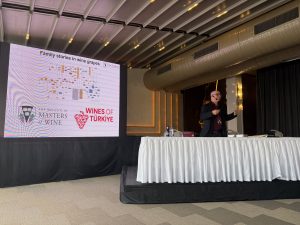
Notes from José Vouillamoz's Presentation in Istanbul
Vouillamoz had the opportunity to develop his expertise in grapevine genetics at the University of California, Davis, under the guidance of Carole Patricia Meredith, one of the pioneers of the discipline. One particularly striking anecdote he shared concerned the cost of an early DNA research project in which he had not personally participated. According to Vouillamoz, the project cost $23 million. Today, comparable genetic analyses can be performed for just a few hundred dollars. It is difficult to imagine a more striking illustration of how technological progress has transformed research costs.
One thing is certain: decoding DNA profiles now gives us access to information that was previously beyond our reach. In his presentation, Vouillamoz took us on a journey through the intricate world of grapevines, revealing relationships made visible by this powerful scientific tool. Let's explore some of the highlights of that journey.
Chardonnay's Unexpected Parent: Gouais Blanc
Chardonnay is one of the world's best-known white wine grape varieties. But did you know that one of its parents is Gouais Blanc, a grape long regarded as ordinary, even worthless?
Genetic research published in 1999 established that Chardonnay originated from a natural crossing between Pinot and Gouais Blanc. And Chardonnay was not the only important variety produced by this pairing. Gamay and Aligoté were among its other offspring. During his presentation, Vouillamoz identified 21 varieties descended from this particular combination.
Gouais Blanc's genetic influence extends much further. According to the presentation, it is a parent of more than 82 grape varieties. Well-known grapes such as Riesling and Furmint also belong to its extended family tree.
The contribution of this once-neglected grape to Europe's viticultural heritage is truly remarkable. That is why Vouillamoz calls Gouais Blanc the Casanova of the grapevine world. Today, Gouais Blanc itself is cultivated by relatively few producers. Vouillamoz identified 18 producers worldwide who work with the variety. He also explained that, together with these producers, an initiative had been launched to establish February 2 as International Gouais Blanc Day. Although the initiative has not yet received official recognition, the producers apparently celebrate the occasion every year by raising a glass of Gouais Blanc.
Who Is Kolorko, Really?
One of the most intriguing parts of the presentation from Türkiye's perspective concerned Kolorko. Found along the northern shores of the Sea of Marmara, particularly around Tekirdağ, Kolorko was long considered a local grape variety.
Vouillamoz first encountered Kolorko in 2012 during the Digital Wine Communication Conference in İzmir. The grape was introduced to him by Seyit Karagözoğlu, founder of Paşaeli Winery, and subsequently became the subject of genetic research. DNA analyses carried out in 2017–2018 revealed that Kolorko is genetically identical to Furmint, the famous grape associated with Hungary's Tokaj region. We have also explored this finding in in a separate article.
This discovery raises a new question: how did Furmint travel from Hungary to Thrace? During his presentation, Vouillamoz drew attention to the life of the Hungarian nobleman Francis II Rákóczi (1676–1735) in Ottoman territory, suggesting a possible historical connection. But an important distinction must be made. The genetic identity of Kolorko and Furmint is a research finding. The date and route by which the grape reached Thrace remain unanswered questions. The Rákóczi connection is, for now, a hypothesis.
And Kolorko's story does not end there. One of Furmint's parents is Gouais Blanc. The other is a grape known as Bisetta or Alba Imputotato. This second parent is also at the center of another fascinating connection involving Turkish viticulture. Together with Prokupac, a grape of Serbian origin, it has been identified as one of the parents of Papazkarası. Through their genetic family trees, therefore, two grapes associated with Thrace, Kolorko and Papazkarası, can be linked to varieties from Central Europe and the Balkans.
Çalkarası: A Connection from Denizli to Crete
Another important story for Türkiye concerns Çalkarası. Closely associated with the district of Çal in Denizli, this grape is one of the defining varieties of the region's viticultural culture. Traditionally known for rosé production, it has increasingly been used to produce red wines as well.
DNA research conducted by Vouillamoz in 2017, but not yet published in a scientific journal, indicates that Çalkarası is genetically identical to Liatiko, a variety grown on the island of Crete. This finding offers an important starting point for exploring historical viticultural connections between the two sides of the Aegean Sea. Was Çalkarası brought from Anatolia to Crete? Did it travel in the opposite direction? Or did both regions receive it from somewhere else? Genetic identity alone cannot answer these questions. It does, however, provide a compelling reason to investigate the viticultural histories of the two regions together.
Recent research by Vouillamoz in the Taurus Mountains has added another dimension to this story. Working with Burak Özkan and Göknur Gündoğan of Likya Wines, Vouillamoz explored old grapevines around Antalya. In the Selge region, they studied vines growing up and around trees. During the presentation, he revealed that DNA analysis had identified one of the collected samples as Çalkarası.
This finding suggests that Çalkarası may have a history extending far beyond Denizli. The genetic connection linking Çal, Crete, and the Taurus Mountains raises new questions about a chapter of Anatolian viticultural history that remains insufficiently explored.
A Grape from Nine Hundred Years Ago: Savagnin
Genetic research is not limited to identifying the parents of grape varieties. Sometimes it can confirm the identity of a grape that has survived from the distant past into the present. DNA analysis of approximately 900-year-old grape seeds discovered at the Prieuré de La Madeleine archaeological site in Orléans, France, revealed that one of them genetically matched the variety we know today as Savagnin.
Published in Nature Plants in 2019, the study was significant because it demonstrated that a grape variety cultivated today had already existed with the same genetic identity centuries earlier. For this reason, Vouillamoz presents Savagnin as one of the oldest genetically verified wine grape varieties.
But Savagnin's story is not only about its age. Varieties such as Chenin Blanc, Sauvignon Blanc, Grüner Veltliner, and Trousseau also feature in its extensive family tree. When examining the geographical distribution of these varieties, Vouillamoz drew attention to the historic pilgrimage routes leading from France through Spain to Santiago de Compostela. Could the routes along which people travelled also have been routes along which grapevines were transported? This possibility illustrates how fascinating the results can be when genetic findings and historical geography are considered together.
Merlot's Missing Parent
Merlot is one of the world's most widely cultivated red wine grape varieties. Yet until relatively recently, only one of its parents, Cabernet Franc, was known. The identity of the other parent remained a mystery for many years.
The story began in 1996 with an old vine discovered in Saint-Suliac, in the Brittany region of France. Other old vines previously found in the Charentes and Gers regions were subsequently shown to share the same genetic identity. The grape was named Magdeleine Noire des Charentes.
Research published in 2009 established that Magdeleine Noire des Charentes and Cabernet Franc were the natural parents of Merlot. It was no coincidence that Vouillamoz presented this discovery almost like a detective story. The missing parent of one of the world's most famous grape varieties had been found not in commercial vineyards, but among a handful of old vines that had survived in different regions.
Few examples demonstrate more clearly why the preservation of old vines and forgotten local varieties matters.
Syrah's Italian Relatives
The final story in the presentation concerned Syrah.
For many years, different theories were proposed about its origins. DNA analysis eventually established that Syrah originated from a natural crossing between Dureza and Mondeuse Blanche, two varieties associated with southeastern France.
Although this discovery identified Syrah's immediate parents, its wider family story does not end there. Vouillamoz's research has revealed genetic connections within Syrah's family tree to varieties cultivated in Italy, including Teroldego and Aglianico.
The question posed during this part of the presentation, “Is Syrah half Italian?”, was less a definitive statement about geographical origin than an invitation to reconsider the histories of grape varieties we tend to regard as belonging to separate national traditions. DNA research suggests that varieties now closely associated with the viticultural identities of different countries may have been much more intimately connected in the past than we once imagined.
The Future of Grapevines May Be Hidden in Their Past
One of the most important lessons from José Vouillamoz's presentation is that grape varieties should not be judged solely by their present commercial value. Another story he told about Gouais Blanc illustrates how the variety was once perceived. According to Vouillamoz, some vineyard owners planted Gouais Blanc along the outermost rows of their vineyards to protect varieties they considered more valuable. The idea was that anyone entering the vineyard without permission would first encounter these less-prized grapes. The discovery that a variety once regarded as second-rate is actually a parent of some of the world's most highly valued grapes is a delightful irony of history.
The discovery of Merlot's missing parent among a few surviving old vines reminds us of the same truth.
For Türkiye, the findings concerning Kolorko, Papazkarası, and Çalkarası are particularly significant. They open new possibilities for investigating the relationships that Anatolian and Thracian viticulture have maintained with neighboring regions throughout history.
But perhaps the most important varieties are those that have not yet been studied. We still do not know what genetic stories may be hidden in old village vineyards, abandoned fields, or vines that continue to climb trees in different parts of Anatolia.
Vouillamoz's research in the Taurus Mountains demonstrates that this question concerns not only the past, but also the future. A grape variety considered economically insignificant today may possess characteristics that become valuable to viticulture tomorrow. As we confront climate change, drought, diseases, and changing growing conditions, some of the genetic traits we will need may be found in the very vines we are currently neglecting to preserve.
A Final Thought
Let us conclude with an intriguing observation from Vouillamoz. Today, breeding programs aimed at developing new grape varieties resistant to fungal diseases, commonly known as PIWI varieties, draw on genetic characteristics from different grapevines.
Vouillamoz explained that his own approach is somewhat different. He also suggested, with a hint of frustration, that his proposal has not received the attention he believes it deserves. His idea is based on a simple question: Why not bring Pinot and Gouais Blanc, two varieties whose natural crossings have produced dozens of outstanding grapes throughout history, back to the center of breeding programs using today's scientific and technological capabilities?
When we consider the remarkable varieties that emerged from natural crossings between these two grapes, it is difficult not to wonder what such an approach might produce. Perhaps some of the answers we are searching for in the future of viticulture lie hidden in this extraordinary genetic partnership from the past.
Thank you, José, for broadening our horizons.
References
- José Vouillamoz, Family Stories in Wine Grapes, Masters of Wine in Türkiye, 2026. Presentation.
- Bowers et al. (1999). “Historical genetics: the parentage of Chardonnay, Gamay, and other wine grapes of Northeastern France.” Science, 285, 1562–1565.
- Lacombe et al. (2013). “Large scale parentage analysis in an extended set of grapevine cultivars.” Theoretical and Applied Genetics.
- Laucou et al. (2018). “Extended diversity analysis of cultivated grapevine Vitis vinifera with 10K genome-wide SNPs.” PLOS ONE, 13(2).
- Ramos-Madrigal et al. (2019). “Palaeogenomic insights into the origins of French grapevine diversity.” Nature Plants, 5, 595–603.
- Boursiquot et al. (2009). “Parentage of Merlot and related winegrape cultivars of southwestern France: discovery of the missing link.” Australian Journal of Grape and Wine Research, 15(2), 144–155.
- Vouillamoz and Grando (2006). “Genealogy of wine grape cultivars: ‘Pinot’ is related to ‘Syrah’.” Heredity, 97(2), 102–110.
Note: The genetic identities of Kolorko–Furmint and Çalkarası–Liatiko, as well as the Çalkarası finding in the Taurus Mountains, were presented by Vouillamoz as results of research that had not yet been published.