A City Shaped by the Küçük Menderes
İzmir’i ziyaret edip Efes’e gitmeyen yerli veya yabancı turist yoktur desek herhalde çok abartmış olmayız. Efes, eski adıyla Ephesos, Türkiye’nin antik kentleri arasında dünyada en çok bilinenlerden biridir. Ama antik dünyanın ünlü liman kenti Ephesos’a gittiğimizde ilk şaşkınlığımızı yaşarız: “Ephesos şarap ve bağcılık” konulu yazıya başlarken Ephesos’un denizi olmayan bir liman kenti olduğunu öğrenir, tarihin garip bir cilvesi olduğunu fark ederiz.
Throughout history, a city’s relationship with water has often been one of the forces that determined its fate. Some cities stand by the sea, others beside rivers or lakes. But for all of them, water has played an undeniable role in sustaining life.
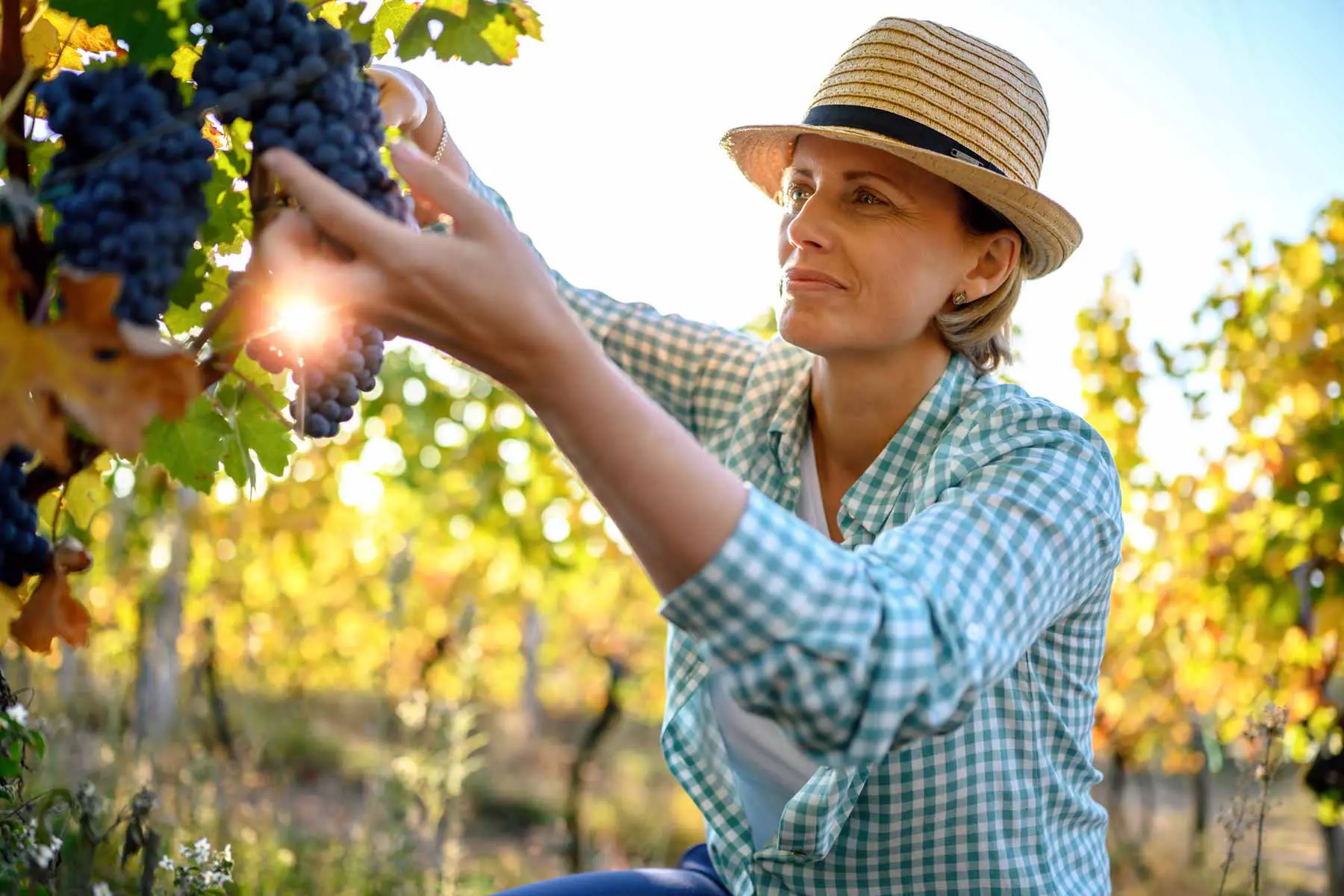
Ephesos had a twofold relationship with water. Its position on the Aegean coast made it a port city, while the Küçük Menderes, the ancient Kaystros, both nourished its agricultural hinterland and threatened the harbour with the alluvium it carried downstream. Over the centuries, this accumulation of sediment altered the coastline, made it increasingly difficult to keep the harbour open and eventually brought the city’s relationship with the sea to an end.
As you might expect, when we look at Ephesos, viticulture and wine culture naturally come to the fore. The valley through which the Küçük Menderes flows, the slopes surrounding it and a climate shaped by the Aegean provided favourable conditions for agriculture and viticulture. But it would be a mistake to look for Ephesos’s importance in wine history only in the vineyards around the city.
One of the main protagonists in this story was the harbour. The harbour of Ephesos did more than carry wine produced in the region to other Mediterranean ports. Wines arriving from different production regions around the Mediterranean also entered Ephesos through the same harbour.
Ephesos was not merely a city where wine was produced. It was a city through which wine moved.
Panormos: Anatolia’s Gateway to the Mediterranean
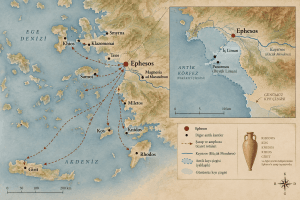
Because of the geographical setting in which Ephesos developed, the city had to rely on more than one harbour. This is evident both from ancient texts and from the work of the Austrian Archaeological Institute and Helmut Brückner. In the Roman period, the sheltered Inner Harbour at the end of the Arkadiane, in front of the theatre, served the city’s commercial agora and storage facilities. But alluvium carried by the Küçük Menderes gradually silted up the harbour.
There is a revealing episode here worth pausing over, one in which human attempts to control nature produced almost exactly the opposite of what was intended. As sediment carried by the river made the harbour increasingly shallow and difficult for the large ships of the period to enter, an ingenious engineering solution was attempted during the reign of Attalos II. It was thought that narrowing the harbour entrance would accelerate the current and carry the accumulated sediment out to sea. Nature, however, declined to follow the engineers’ calculations. Instead of producing the expected flushing effect, the narrowed entrance made it easier for sediment to accumulate inside the harbour. Silting accelerated, as did the harbour’s transformation into marshland. It was one of those moments in the history of Ephesos when humans tried to reshape geography, only for geography to have the final word.
As a result, Panormos, which could accommodate large ships, came to serve as the great harbour of Ephesos, while the Inner Harbour, accessible only to vessels with a shallower draught, became a point where goods were transferred.
Ephesos Through the Story Told by Amphorae
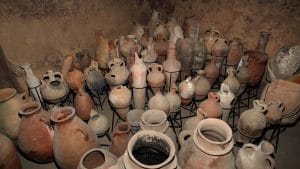
The monumental Arkadiane, the Harbour Street running from the port into the city, should not be seen merely as an impressive boulevard. It was one of the principal routes by which people and goods arriving by sea entered Ephesos. The Tetragonos Agora, reached along this axis, was one of the centres of the city’s commercial life. Amphorae discovered there provide important clues to the economic world of Ephesos. What we find are not only local vessels. Amphorae associated with Rhodes, Kos, Knidos, Chios, Crete and other production centres also reached Ephesos.
This reveals an important distinction. We should not think of Ephesos simply as a city that produced and exported wine. It was also a major Mediterranean hub where wines from different regions arrived, were consumed, changed hands and continued their journeys elsewhere.
The story of wine in Ephesos is therefore much larger than the vineyard.
If you want to trace the movement of wine in the ancient world, you often have to follow not the wine itself, but its container. In this respect, the amphora is one of the silent records of ancient trade. We know that amphorae were also produced in Ephesos and its surrounding region at different periods. But it would be misleading to speak of a single, unchanging “Ephesos amphora”. Over the city’s long history, both production practices and amphora types changed. Archaeological finds extending through the Roman and Late Antique periods show that local production continued for centuries in different forms.
Bunlardan biri olan ve arkeoloji literatüründe Ephesos 56 One of these, known in archaeological literature as Ephesos 56, belongs to a much later period, roughly from the late fourth century AD into the sixth and early seventh centuries. It therefore cannot be treated as a direct witness to Domitian’s decree of AD 92, which we will encounter shortly. But the amphorae found at Ephesos tell us a larger story.
Kent hem üretiyor hem tüketiyor, hem dışarıya mal gönderiyor hem de Akdeniz’in farklı üretim bölgelerinden ürün alıyordu. Şarap da bu karmaşık dolaşım sisteminin içindeydi. Bu nedenle Ephesos’un şarap tarihindeki önemini tek bir amphora tipine ya da tek bir “ünlü Ephesos şarabı”na bağlamak yerine, yüzyıllar boyunca devam eden üretim ve dolaşım sisteminde sahip olduğu yeri değerlendirmek daha doğru görünüyor.
Was the Wine of Ephesos Really Famous?
There is an easy trap to fall into when telling the history of wine in antiquity: once we encounter an important city, we tend to assume that its wine must also have ranked among the most prized wines of the ancient world. The sources we have for Ephesos paint a more complicated picture.
Yaşlı Plinius, Naturalis HistoriaPliny the Elder mentions the wine of Ephesos in his Naturalis Historia. But it would be difficult to describe his comments, in modern terms, as praise for a “high-scoring wine”. On the contrary, he notes the use of seawater and boiled-down must in its preparation and does not assess it favourably from a health perspective. Yet this detail does not diminish the importance of Ephesos. Quite the opposite. It teaches us something more valuable:
A city’s importance in wine history cannot be measured simply by how highly ancient writers rated its wine. Ephesos mattered because it stood beside a viticultural hinterland, sustained a large population, produced amphorae, received wines from different regions and possessed a major harbour connected to the Mediterranean trading system.
Here, wine was not merely a drink for elite tables. It was part of a vast economy.
AD 92: The Imperial Hand Reaches the Vines
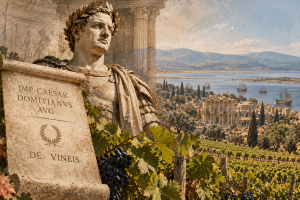
It was precisely for this reason that a decree issued from Rome in AD 92 must have posed a serious threat to Ephesos and other wine-growing regions of the province of Asia. Emperor Domitian issued a measure prohibiting the planting of new vineyards in Italy and ordering a substantial proportion of the vineyards in the provinces to be removed.
According to Suetonius, the decision was prompted by an imbalance between abundant wine production and insufficient grain production. Land devoted to vineyards was thought to be reducing the amount available for growing grain. Modern scholars have proposed different interpretations of the economic motives behind the measure, including a desire to protect Italian producers from competition from provincial wines. The reason explicitly given by the ancient sources, however, is the tension between land devoted to grain and land planted with vines.
How extensively the decree was actually enforced is another question. Suetonius also tells us that Domitian did not ultimately insist on its full implementation. And it is here that we encounter a remarkable story involving the wine-growing cities of Asia.
To Rome for the Vineyards of Asia: Skopelianos
Antik yazar Philostratos’un aktardıklarına göre, Domitianus’un bağlara yönelik düzenlemesi Küçük Asya’da ciddi tepki yarattı. Bu kararı değiştirmesi için imparatoru ikna etmek amacıyla İonia’nın kentleri Roma’ya bir heyet gönderdi. Bu diplomatik girişimin en dikkat çekici ismi, dönemin ünlü sofistlerinden Skopelianos idi. Skopelianos Ephesoslu değildi; Smyrna ile ilişkiliydi. Dolayısıyla hikâyeyi “Ephesos’un Roma’ya karşı zaferi” olarak anlatmak doğru olmaz. Fakat belki bundan daha önemli bir şey anlatıyor.
Viticulture had ceased to be merely an economic activity of individual cities and had become a regional concern shared by different communities across Asia. When imperial agricultural policy intervened in local economies, cities could use Rome’s own political mechanisms to defend their systems of production. In the end, Domitian’s order to remove the vineyards was not implemented to the extent originally envisaged.
The vines remained.
The Memory of the Soil
Today, when we walk along Harbour Street at Ephesos and reach the Tetragonos Agora, we can no longer see the sea.
Panormos is gone.
The ships are gone.
The voices of the porters, merchants and sailors who carried the amphorae have long since fallen silent.
Yet the amphora fragments uncovered by archaeology still allow us to draw another map: a map of circulation stretching from Rhodes to Kos, from Knidos to Chios, and from Ephesos to distant ports across the Mediterranean. On this map, wine is not merely a drink. It is agriculture, craft, pottery, seafaring, commerce and, ultimately, politics. tarım, zanaat, seramikçilik, denizcilik, ticaret ve sonunda siyasettir.Perhaps this is where the true importance of Ephesos in the history of wine lies.
Just as we cannot always know where the vineyard begins, we cannot easily tell where the story of wine ends.