It has been ten years since our first visit to Mardin, and we have to admit that we deeply regretted to have discovered the city so late after we returned from that trip. At the time, we were running our pizza restaurant, BEPPE and our visit to Mardin left a tangible mark on our menu. The Mardin kebab we tasted at the modest establishment Kebapçı Yusuf found its way into BEPPE in a new form: the Mardinella pizza.
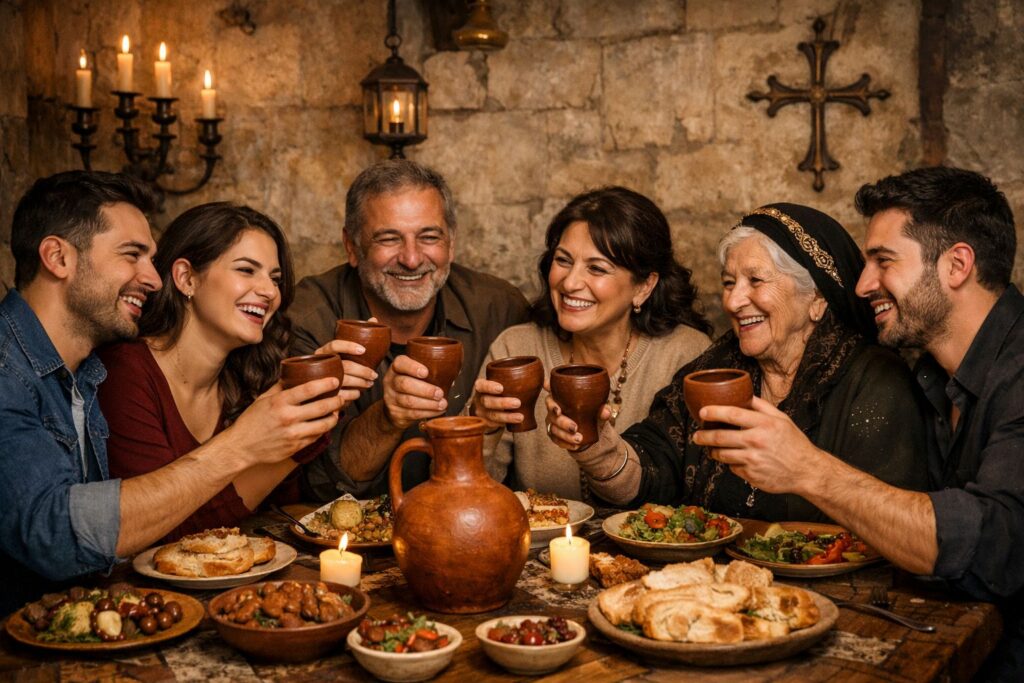
O gezideki akşam yemeklerimizden birisini yörenin öne çıkan işletmelerinden Cercis Murat Konağı’nda yemiştik. Deneyimin otantik olması için metal kadehlerle şarap servis edildiğini hatırlıyorum. Otantikliği sağlamanın metal kadehten geçmediğini düşünmüştüm yemek esnasında. İlerleyen yıllarda şarapla ilgili çalışmalarım ilerledikten sonra geriye dönüp baktığımda, bölgeyi en iyi temsil edecek kadehlerin toprak kaplar olacağını düşünmüşümdür. Ama en azından farklılığı önemseyen bir yaklaşıma sahip işletme olmaları, başlı başına ayırt ediciydi. Mezopotzmya topraklarının saklı hafızasında yolculuk ederken, bu köklü mirasın günümüzdeki yansımalarını anlamak kritik önem taşıyor. Bu konudaki detaylı analizimiz için “Süryani Bağcılık ve Şarçılık Kültürünü Doğru Değerlendirmek” başlıklı makalemize göz atabilirsiniz.
This time, our visit to Mardin is not a casual journey but rather a field study which involves meetings with Syriac wine producers, and a search for the most accurate understanding ahead of our Syriac wine tasting. But, most importantly, an exploration of wine’s central place within Syriac culture. So we begin.
The Sacred Origin of Wine: Faith and the Table
Wine, as we know, is produced across many regions of the world between the 30th and 50th parallels, an area often called the “wine belt.” Yet in Mesopotamia, the cradle of civilization, wine is more than an agricultural product—it is the language through which the soil speaks.
The Syriacs, a people who have lived on these lands for thousands of years and preserved their language and faith against all odds, transformed viticulture and winemaking into a way of life—indeed, into a strategy of survival. Within Syriac culture, wine is not merely a source of pleasure. For more than sixteen centuries, it has been an inseparable aspect of religious rituals, the heart of the Eucharistic ceremony of Bread and Wine. In church tradition, wine symbolizes spiritual transformation. This sacred meaning permeates every stage of production. In traditional Syriac households, winemaking is not simply a seasonal preparation. It is a ritual, a moment when families gather, prayers are spoken, and the finest grapes are selected. This process explains why Syriac wine retains its unmistakable identity as a domestic, living product.
Tur Abdin: The Mountain of Servants and Its Vineyards
For the Syriacs, the region known as Tur Abdin—“the Mountain of the Servants of God”—encompassing Mardin, Midyat, and their surroundings, is the homeland of viticulture. The vineyards here carry a genetic memory shaped over millennia. What distinguishes Syriac wine begins with the grapes themselves.
Mazrona:
Bölgenin en karakteristik beyaz üzümü. Meyvemsi, aromatik ve dolgun yapısıyla Süryani beyaz şaraplarının ana omurgasını oluşturur.
Karkuş:
Süryani şarapçılığının olmazsa olmazı, “etine dolgun” ve karakteristik beyaz üzümü. Genellikle Mazrona ile harmanlanarak şaraba o beklenen gövdeyi, asiditeyi ve damaktaki kalıcılığı verir. Karkuş, bölgenin kireçli toprak yapısını kadehe en iyi yansıtan türlerden biridir.
Boğazkere:
Mezopotamya’nın o sert, tanenli ve mağrur kırmızı üzümü. Anadolu topraklarının belki de en karakteristik şaraplarını verir.
Is “Syriac Wine” a Category?
Today, when we see signs reading “Syriac Wine Has Arrived” in shop windows, they do not refer to a technical classification. They refer to a cultural identity. Syriac wine is not an appellation governed by strict regulatory frameworks like those of France. Instead, it represents the collective taste, memory, and craftsmanship of a community.
So, what makes it different?
Doğallık ve Müdahalesiz Üretim:
Geleneksel Süryani şaraplarında endüstriyel mayalar yerine üzümün kendi kabuğundaki vahşi mayalar kullanılır. Bu da her şişede rekolteye ve bağa özgü, bazen öngörülemez ama her zaman özgün bir karakter sunar.
Mahzen Kültürü:
Mardin ve çevresindeki kalkerli yapı, doğal bir serinlik sağlar. Şaraplar, yerin altındaki o serin ve karanlık “serdap”larda olgunlaşır.
Halkın Şarabı Olması:
Süryani şarabı, büyük fabrikaların değil, aile işletmelerinin ve manastır geleneklerinin ürünüdür.
The Historical Strength of Syriac Wine
Wherever you travel in Anatolia, traces of viticulture keep you company. Wine here is not a modern invention; it is an archaic continuity. Mardin stands at the intersection of two distinctive forms of heritage: a tangible heritage shaped over millenia, and a living winemaking tradition sustained by the Syriac community for over two thousand years.
Near Artuklu, the ancient settlement of Çelbira offers a striking example. Its limestone terrain not only shaped the character of its vineyards but also created naturally temperature-controlled environments essential for winemaking. Today it survives as an archaeological site, but in its time, it served as an active center of agricultural and technological knowledge.
Historical records suggest that the Syriacs had a relationship with wine even before Christianity. But after its adoption, wine assumed an even more central role, safeguarded by monasteries as a sacred necessity.
Two guardians ensured its survival:
Manastırlar:
Dinî ritüellerinin devamlılığı için bağlara ve şarapçılığa kol kanat geriyorlar.
Süryani Ahali:
Kendi atalarından aldıkları terbiyeyle şarap, her evin tarhana, salça gibi ayrılmaz gıdalarından birisi oluyor.
March 15: More Than a Tasting
At its core, Syriac wine was never intended as a commercial product. It is a family wine, produced from grapes grown in personal vineyards and shared with guests. Its makers do not chase aromatic perfection or technical precision. They preserve something else: continuity.
These wines are vessels of memory, held in clay and stone for generations, reflecting hospitality and endurance. On March 15 at WAYANA, we will not just taste different blends. As we experience the elegance of Mazrona and the strength of Boğazkere, we will also taste Syriac community’s resilience. Together, we will ask such questions as: What makes Syriac wine different? Is it technique? Or, is it the weight of history itself?
In truth, Syriac wine stands as the embodiment of simplicity and tradition in an increasingly complex world. The signs on shop windows tell only one part of the story. The real story waits deeper, in the glass.
Kadim Süryani kültürü ve şaraplarıyla ilgili kaleme aldığımız başka yazılarımız da var. Aşağıdaki linkler yardımıyla ulaşıp göz atabilirsiniz.
The Syriac Viticulture and Wine Tradition: A Living Heritage of Upper Mesopotamia
Monasteries and Viticulture: The Position of Syriac Monasteries