The history of wine is not only the story of an agricultural transformation; it is also the history of narrative making. Every scientific model explaining the domestication of the grape has gradually evolved into cultural, political, and economic discourse. Academic hypotheses have often become part of national identity narratives. For this reason, the question “Where was the grape domesticated?” is not merely an archaeobotanical matter. It is also a claim of origin. And claims of origin generate power.
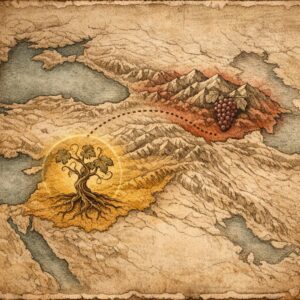
Over the last fifty years, scientific perspectives on grape domestication have undergone a profound transformation. The Single Origin Model, dominant in the 1970s, began to fracture with the rise of molecular research in the 2000s. A comprehensive genomic analysis published in 2023 (Science, add8655) provided strong evidence for a dual domestication model. This shift represents more than an academic revision. It is a rupture that requires us to rethink many established narratives about the history of wine.
I. The 1970s: A Simple and Powerful Story – The Single Origin Model
During the second half of the twentieth century, the prevailing view was straightforward: Vitis vinifera had been domesticated in Western Asia and later spread to Europe through Anatolia and the Balkans. The diversity of European varieties was considered merely the result of this diffusion.
This model was compelling because it aligned with archaeological evidence and did not contradict the limited genetic data available at the time. The idea of a single “birthplace” also functioned as a clear and useful symbol in identity construction.
II. 1980s–2000s: Archaeology Enters the Laboratory
The linear narrative of the 1970s began to deepen with the work of researchers such as Patrick McGovern, who analyzed tartaric acid residues in ancient vessels. These biomolecular studies provided laboratory-level evidence that wine production existed in the Neolithic period.
However, while these analyses confirmed the presence of wine production, they could not yet fully explain the genetic structure of grape domestication.
III. 2000–2017: Molecular Cracks Appear
With the arrival of molecular genetic methods in the early 2000s, scientists began to observe something intriguing: European cultivated varieties appeared to have hybridized with local wild vines (Vitis sylvestris).
This suggested that European diversity was not simply the result of a straightforward east-to-west diffusion. Local wild populations had clearly played a role in shaping the vineyards of Europe.
The scientific community began to suspect something fundamental: perhaps domestication had not been a single event.
IV. 2017: Cultural Recognition and a Powerful Narrative
While scientific debates continued, Georgia’s qvevri winemaking tradition was recognized by UNESCO. Public discourse simplified the scientific complexity into a powerful tourism message:
“Wine was born here.”
Cultural diplomacy prefers clarity. Genetic data, however, was quietly preparing a more complex story.
V. 2023: The Genomic Breakthrough – Dual Domestication
A massive study published in Science analyzed more than 3,500 grape samples and demonstrated the existence of two independent domestication lineages:
- Near East / Anatolian Lineage (CG1): the ancestor of modern table grapes
• Caucasian Lineage (CG2): an independent center for wine grapes
These parallel processes began roughly 11,000 years ago, effectively overturning the single-origin model.
Perhaps the most striking discovery was this: humanity did not create domesticated grapes from nothing. Many traits we consider “cultural,” such as those leading to white grapes, were already present as natural mutations within wild vine populations thousands of years before domestication. Humans merely recognized these traits and selected them.
VI. Anatolia: The “Hidden” Ancestor of European Wine
This new framework places Anatolia in a strategically important position.
Many European wine varieties now regarded as “noble” emerged from the genetic marriage between vines migrating from Anatolia (CG1) and Europe’s local wild vines (Syl-W). European wine culture owes much of its character and adaptability to this hybridization.
VII. A New Narrative: Not a Single Root, but Intertwined Roots
When scientific models change, cultural narratives tend to move more slowly. The idea of a single origin remains romantic and appealing.
Today, however, two parallel interpretations coexist:
- Cultural Narrative: Wine culture appears early in the Caucasus through archaeological evidence.
• Scientific Reality: Grape domestication occurred through parallel processes in Western Asia and the Caucasus.
The birth myths of wine are now being rewritten not only in archaeological excavations, but also in DNA sequencing laboratories.
The beginning was not singular. It was neighboring.
Perhaps this is the narrative most faithful to the nature of wine itself: not one single root, but thousands of roots intertwining deep in history.
VIII. The Anatolian Paradox: Not Just a Beginning, but a Port of Return
The extraordinary diversity of the Anatolian vine inventory cannot be explained solely by early domestication. For thousands of years, Anatolia functioned as a major crossroads of vine circulation.
The data presented in the Science article illustrates this movement clearly. Vines departing Anatolia (CG1) migrated westward, hybridized with Europe’s local wild vines (Syl-W), and eventually formed new wine-grape lineages (CG3–CG6).
But the story does not end there.
IX. Kolorko and Furmint: A Genetic Story of “Coming Home”
One of the most fascinating examples of this cycle is the genetic relationship revealed between Kolorko and Furmint.
This case supports the model described above: a vine originating in Anatolia travels west centuries ago. In Europe, it deepens its wine character through genetic exchange with a local wild vine and becomes Furmint. Later, through trade routes or migration, it returns to its homeland with a new name and a refined identity: Kolorko.
This phenomenon also helps explain why the Turkish vine inventory is so remarkably rich. Our vineyards contain not only vines that were “born here,” but also the genetic descendants that helped build European wine culture and later returned home.
Conclusion: Intertwined Roots
The birth myths of wine are now being rewritten not only through archaeological discoveries but also through DNA sequencing machines.
The genomic data published in 2023 shows us that the beginning was not a single point, but rather the simultaneous heartbeat of two neighboring centers: Anatolia and the Caucasus.
Wine did not originate in one place and simply spread across the world. As it traveled, it changed, hybridized, and evolved. Eventually, it returned to where it began, to Anatolia, carrying a richer genetic identity.
Perhaps this is why discovering Anatolian wines today feels like witnessing the completion of the vine’s thousands-year-long circular journey.