In the first two chapters of our series, we examined that exhilarating “first moment” when Samuel Pepys discovered “Ho Bryan” in a London tavern, and Robert Boyle’s observations on the chemical evolution of wine in sealed glass vessels. At first glance, one might reasonably ask, “What do these two have to do with each other?” They seem unrelated. Yet, rather surprisingly, they converge on the same foundation: the scientific underpinnings of fine winemaking.
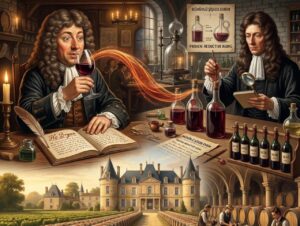
In the last quarter of the 17th century, the wines of Bordeaux entered a period of profound transformation. A region already known in certain circles began its rapid ascent toward becoming one of the most prestigious names in the world. The change was multidimensional. Gastronomy absorbed its share of the shift, while the scientific world had already embarked on what would become an unstoppable marathon.
In this chapter, we will see how this multi-axial transformation helped shape what we now call the prestigious category of Fine Wine.
“New French Wine”: Meeting Expectation
From the 1660s onward, European politics, particularly the tense relationship between England and France, created a curious paradox in the wine trade. Heavy customs duties and commercial embargoes rendered ordinary French wines uncompetitive in the English market. Taxes rose to such heights that the logistical cost of bringing a low-quality wine to London could exceed the wine’s own value. (Given how transportation costs still reshape agricultural markets today, this logic feels strikingly familiar.)
Meanwhile, the English aristocracy and the newly wealthy merchant class began to reason differently: “If we are paying such high taxes, then what we drink must be worth every penny.” This shift in expectation pushed Bordeaux producers toward a radical decision: produce less, produce better, sell at a higher price.
Thus, the strongest consumer market in the wine world, England, aligned with Bordeaux’s evolving production strategy, giving birth to what became known as “New French Wine.” The term “Claret” no longer referred merely to light-colored, delicate wines meant for quick consumption. Producers began crafting darker, fuller-bodied, higher-tannin wines aged extensively in barrel, wines designed to mature over time. The distinctive flavor that so impressed Pepys was not an accident; it was the result of deliberate technical innovation in pursuit of quality.
Viewed from today’s perspective, this moment marks the early emergence of the Fine Wine segment. Rising taxes reshaped market conditions, and consumers no longer sought ordinary barrel wine. They began to expect the rare bottle, almost like an elixir.
The Rise of the Châteaux and the Birth of Terroir Awareness
Haut-Brion, or “Ho Bryan” in Pepys’s spelling, pioneered the model of marketing wine under the name of the estate. Other major producers quickly followed. Margaux, Latour, and Lafite laid the foundations of what we now understand as the château concept.
This was no longer merely a matter of ownership or branding. For the first time in wine history, the unique value of a specific parcel of land, later crystallized in the concept of terroir, began to be consciously recognized. The soil, the vines rooted in it, and the production techniques specific to that estate were seen as integral to the wine’s identity.
Boyle’s laboratory demonstrations of wine’s capacity to improve in bottle became a powerful marketing asset for these rising estates. If wine could evolve and refine itself over time in sealed glass, then the quality of the vineyard itself became paramount. Producers no longer simply “made” wine; they began to design it as something that would be consumed years later, almost as one would conceive a work of art.
Grapes were harvested more selectively. Fermentation times were refined. The finest corks and the strong English glass bottles necessary for sealed aging, praised in Boyle’s experiments, became essential tools. Bordeaux began its journey from an agricultural region into what would become one of the world’s earliest and most successful luxury brand centers.
Another crucial pillar of the Fine Wine definition was estate-based production. In the years that followed, land classification systems would formalize status distinctions among châteaux. In some cases, the mere presence of a château’s name on the label was enough to propel bottle prices to astronomical heights.
Technical Revolution: Sulfur and Oak
It is important to remember that many of the methods we now call “traditional” were revolutionary at the time. Dutch engineers drained the marshlands of Bordeaux, opening new vineyard areas such as the Médoc, fundamentally altering both production capacity and stylistic character.
At the same time, sulfur use to prevent spoilage and the transformation of oak barrels from simple transport containers into deliberate maturation instruments became standardized practices.
The question Boyle raised about preserving the “body” of wine found its practical answer in the refinement of these techniques. Wine no longer had to be consumed in the state it was in when it left the port. It could cross oceans, rest in cellars for years, and gain value with time. Gradually, wine ceased to be merely a commodity and began to function as an investment.
The Intersection of Science, Pleasure, and Heritage
Looking back at the end of this series, a clear picture emerges. Samuel Pepys helped us understand why this new generation of wine was desirable: social status, intellectual pleasure, prestige. Robert Boyle provided the scientific framework explaining how wine evolved: chemistry, oxidation, and the effect of time on matter.
The worlds of reason and pleasure, represented by these two figures, laid the groundwork for the 1855 Bordeaux Classification and for the standards we now associate with every bottle of Fine Wine in our glass today.
The historical transformation of Bordeaux stands as powerful evidence that wine is not merely an agricultural product. It is a scientific curiosity, a commercial intuition, and a cultural inheritance.
When we read Stevenson’s Travels with a Donkey in the Cévennes or Henry James’s journeys through France in our WAYANA BOOK series, we are following that same spirit of discovery: seeking to understand the story within a glass or a book, together with the historical and scientific layers that brought it into being.
Thus, the excitement Pepys felt on his palate, Boyle’s observations of wine evolving in airless bottles, the rising prices driven by taxation, and the emergence of château-style production converged. From this convergence, the Fine Wine category secured its enduring place in wine history.
*The English use the term “Claret” to refer to wines from the Bordeaux region. The word derives from the French “clairet.” Before the transformation described above, Bordeaux wines were lighter in color and easier to drink. The English adopted the term not for the color but for the region. Even as the wines became darker and more structured over time, the name endured.