From the Earth’s Pulse to the Heart of the Vineyard: Agro-Seismology
We can think of seismology, by way of analogy, as a scientific discipline that takes and interprets X-rays of the Earth. Traditionally, this field relies on highly sensitive instruments called seismometers to monitor massive fractures within the Earth’s crust, tectonic movements, and explosions. By measuring the speed and intensity of waves propagating from beneath the surface, these devices allow us to map depths that are otherwise invisible.
In recent years, however, seismology has undergone a transformation. It is no longer merely a passive observer waiting for earthquakes; it has evolved into an active technology used in fields such as oil exploration, groundwater detection, and the monitoring of structural integrity in urban environments. At this point, DAS (Distributed Acoustic Sensing) technology has taken center stage. By analyzing how light signals traveling through standard fiber optic cables respond to even the slightest environmental vibrations, this system effectively turns thousands of kilometers of fiber optic networks into a vast, continuous sensor.
Agro-Seismology – A New Eye in Agriculture
So, what use does a technology that spans continents have in a vineyard? The answer lies in the “architecture of the soil.” A pioneering study led by the Chinese Academy of Sciences (CAS), with contributions from international scientists, has brought seismology down to agricultural land. This emerging discipline, known as agro-seismology, monitors changes in seismic wave velocities beneath the soil in real time.
- The “Voice” of the Soil: Through fiber optic sensors, scientists “listen” to the movement of water within the soil and its porous structure.
- Tracing Compaction: The impact of heavy machinery (such as tractors) on the soil is detected not only at the surface but also at depth, through an immediate increase in seismic velocity. In compacted soil, waves travel faster—providing scientific evidence that the soil has lost its ability to “breathe” (i.e., its porosity).
- A Revolution for Viticulture: At the core of what we call terroir in viticulture lies the soil. This technology can detect water stress in the vine’s root zone or the physical fatigue of the soil long before any visible damage occurs.
How Does Agro-Seismology Work?
Applying this technology in a vineyard requires a very different “scale” compared to monitoring the Earth’s crust. Agro-seismology tracks the soil’s porous architecture and the movement of water within it with millimetric precision, effectively taking the vineyard’s “pulse.” Let us now explore, through the technical details of a seven-frame visual narrative, what agro-seismology “listens to” in a vineyard—and what it seeks to “protect.”
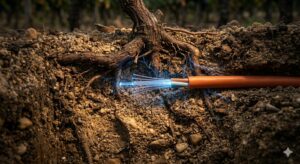
In the first image, a fiber optic cable lies just beneath thick vine roots. Its function is to detect and transmit vibrations within the soil for recording. Chinese researchers deployed this network of fiber optic cables in the root zones of vineyards, assigning it a novel role.
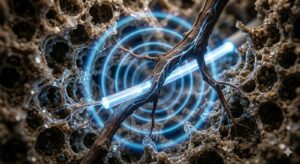
In the second image, the soil structure appears healthy and porous, represented by smooth blue-white rings of light passing through it. Distributed Acoustic Sensing (DAS) measures how water moves through these pores and how the soil’s seismic conductivity changes. The image illustrates how soil moisture conditions can be monitored with millimetric precision before the vine experiences water stress—offering a life-saving early warning system for irrigation and timely intervention.
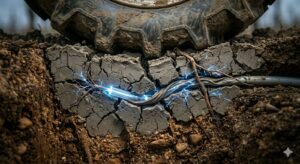
The third image shows soil compaction caused by the weight of a wheel. As the healthy, porous soil structure is compressed, seismic wave velocity increases instantly. The data, visualized as rings of light, weaken, fragment, and partially disappear as they pass through the compacted, dull region.
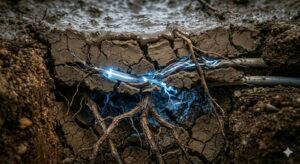
In the fourth image, we see the vine as the primary victim of this process. Its roots are dried and shriveled, turning a dark brown. Compacted soil has prevented water from penetrating deeper layers, causing surface pooling. The break in the fiber optic cable, much like the dried roots, signifies a disruption in data flow.
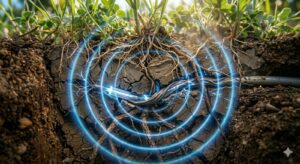
The fifth image conveys regenerative hope. The aggressive roots of cover crops loosen the compacted soil, restoring its porous structure. This recovery is visualized by the reappearance and smooth flow of light rings through the voids created by the roots.
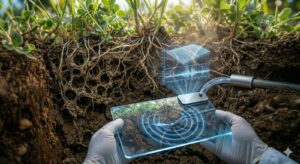
In the sixth image, we observe how these tools are used to monitor the vineyard’s pulse. The data, reflected on a screen, provides immediate insights into the true condition of the soil.
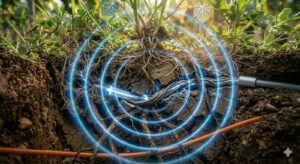
In the final image, we see the soil of a vineyard at peace. A porous structure has formed, allowing roots to grow freely. The blue-white light flows uninterrupted, and the collected data reflects this restored balance.
A Global Vision and the Future of Agro-Seismology
This work is not merely a laboratory experiment; it is the result of a global collaboration that combines the seismological and engineering expertise of the Chinese Academy of Sciences (CAS) with methodologies developed by seismologists in Europe and the United States. The research team aims to transform agricultural lands into “smart and responsive” systems by leveraging fiber optic infrastructure. By listening to the “heapartbeat” of the soil, agro-seismology provides scientific data for sustainable agriculture while preserving the terroir character of the vine.
The Seismic Communication of the Soil
Adapting solutions developed for macro-scale phenomena such as seismology to micro-scale environments like vineyards is, of course, no simple task. It requires moving beyond the notion of soil as merely a composition of clay, sand, and similar materials, and embracing the understanding that it possesses a living, capillary-like system. Through this perspective, fiber optic sensors are able to measure water stress within the soil and monitor its pulse. Today, agro-seismological solutions are becoming part of the toolkit for cultivating high-quality grapes and producing exceptional wines.
The vintners of tomorrow will have access to tools their predecessors never possessed. It remains to be seen what these tools will contribute to the wines of the future.