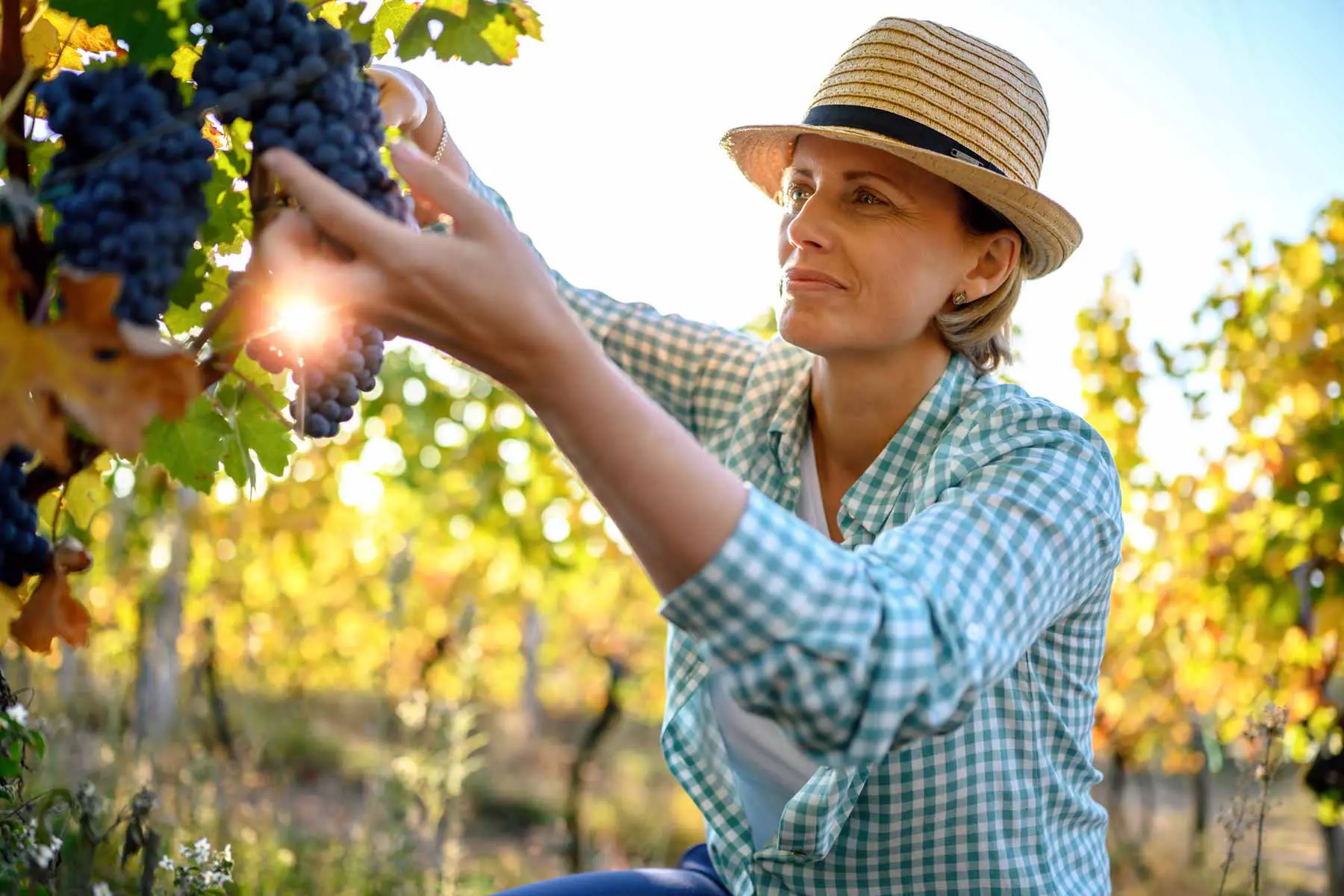
Introduction: “Alright, but What Does This Have to Do with Wine?”
It is impossible not to notice how technological developments over the last twenty years have influenced, and perhaps quietly mortgaged, our lives. The mobile phones that once freed us from cables have evolved into something that can no longer be defined by the word “phone” alone. This wasn’t enough; it triggered the transformation of inanimate objects into smart ones, allowing the Internet of Things (IoT) to seep into the very fabric of our daily existence. Just when we thought we had seen it all, a new curtain is rising: The Internet of Senses (IoS). Technology, which once brought intelligence to inanimate objects, has now set its sights on our most private domains—our senses.
Now, lean back and imagine: It’s late afternoon, and you are browsing the future website of our project, codenamed Terra Anatolia Vinea. You come across an ancient Anatolian grape variety that is on the brink of extinction. You’re curious: “What is the character of this grape?” With a single click, a small device connected to your phone releases the typical notes of damson plum and fresh thyme from its reservoir. You haven’t bought the wine yet, nor have you poured it into your glass, but you’ve already had your first sensory encounter with that grape in a digital environment.
So, is this a sci-fi fantasy or a grounded technological future? Let’s dive into the technical details of this digital vintage.
Part 1: The “Hardware” World of Digital Aroma and Taste
At the heart of IoS in the wine world lies the ability to convert chemical compounds into digital signals. The E-Nose (Electronic Nose) technology used in laboratories today can already “read” the volatile organic compounds (VOCs) in wine and create a digital fingerprint. By the 2030s, there will be no barriers to merging this “reading” process with a “writing” process.
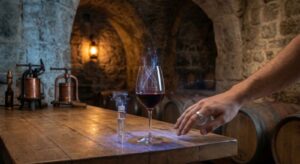
Digital Aroma Kits: Much like an inkjet printer mixes CMYK primary colors to produce millions of shades, new-generation aroma synthesizers will use cartridges containing fundamental scent molecules. When a wine’s digital profile reaches you, the device will blend these molecules at a microliter level, delivering the wine’s unique bouquet directly to you.
Taste Simulation with Electrodes: On the tasting side, things get even more exciting. E-Taste or digital lollipop prototypes send signals to the brain’s taste center via silver electrodes placed on specific areas of the tongue. While electrical impulses simulate sourness and saltiness, thermal stimulation (instantaneous temperature changes) can trigger sensations of sweetness and bitterness on the palate.
This technology will be revolutionary, particularly in wine education. A sommelier candidate will be able to experience acidity levels or tannin intensity (that drying sensation in the mouth) through haptic interfaces and electrodes before even opening a single bottle. At Wayana, we see this as a unique opportunity to explain the complex and rich character of Anatolian grapes to the world.
Part 2: Biometric Matching – Your Body’s Dialogue with Wine
Until now, wine selection was based either on an expert’s recommendation or our past experiences. In the IoS era, this choice is based on “biometric data”—your real-time biological reality.
As wearable technologies (smart rings, heart rate sensors) reach perfection, systems will no longer just analyze “what wine you like,” but “which wine will be good for you at this exact moment.” Biometric matching clashes the static tasting note of the wine with your dynamic biological data.
For instance, if your stress level, measured via Heart Rate Variability (HRV), is high; the algorithm might suggest a crisp, refreshing white wine (perhaps a Narince) to help balance your cortisol levels. Or, if your hydration level is low, it might predict the overwhelming dryness a high-tannin red would cause and steer you toward a more fruit-forward option.
This is not about turning wine into a “prescription”; it is about building the most harmonious bridge between your current emotional and physical “terroir” and the terroir of the grape. Thanks to Emotion AI, the “invigorating” glass offered to you after a tiring workday will elevate your connection with wine to a level of molecular honesty.
Part 3: The Surprise Factor and Human Balance
When technology exerts such dominance, the question immediately arises: “Doesn’t this take all the surprise out of it?”
You’re right; wine is partly about mystery, discovery, and that “wow” effect of the first sip. Simulating everything beforehand might feel like going to the cinema already knowing the ending. However, our vision is this: IoS technology is not a necessity; it is a navigation tool. Just as using GPS doesn’t take away the joy of the walk but simply prevents you from taking the wrong turn, digital tasting tools help you train your palate and reach the flavors that truly resonate with you faster. How much room you give to technological solutions in your life will always be up to you. At Wayana, we know that even the most advanced algorithm cannot replace the feeling of “peace” you get when you close your eyes during that first real sip.
Part 4: The Digital Heritage of Anatolian Grapes – A Protective Shield
The most critical point of this article is the bridge IoS builds with our Terra Anatolia Vinea project. Anatolia possesses a 10,000-year-old wine memory. However, many local grape varieties are facing extinction due to the climate crisis or neglect.
We view IoS not just as a marketing tool, but as a “Sensory Archiving” system. Today, we are digitally “sealing” the scent and taste profiles of ancient, forgotten grapes we find in the remote corners of Anatolia. If a variety faces physical extinction, its “sensory DNA” will continue to live on in our digital library.
In the year 2100, a wine lover will be able to experience the character of that rare Kolorko or Papaskarası you discovered today in the vineyards of Mardin or Central Anatolia through a digital interface. This is the immortalization of a cultural heritage.
Conclusion: The Future Rises from the Soil
Whether it is 2026, 2035, or 2100; no matter how much technology advances, our focus will always be the “real wine” filtered from the unique soil of Anatolia. Digital links, aroma cartridges, and biometric sensors are merely tools. The real goal is to awaken human senses and tell the ancient stories of these lands to the world in a new language.
That one-sip “future” you tasted in your digital aroma kit will ultimately invite you back to the soil itself—to the authentic glasses of Wayana. Because we know that while technology can shorten distances, wine will always remain the warmest and most ancient bond between the land and humanity.
We invite you to Wayana today to experience this sensory future and to protect the heritage of Anatolia.