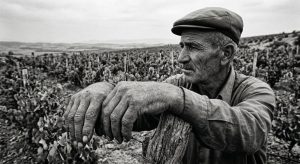
Go to any vineyard village in Anatolia today and look at the hands of the men sitting in the local coffeehouse. To see those calloused hands merely as extensions of a body would be an injustice. Those hands are, at the same time, the final records of an agricultural library thousands of years in the making.
I don’t know if you’ve noticed. That library is quietly burning, and we are standing by, watching the smoke.
The title I’ve chosen is not an expression of pessimism, but a blunt and unvarnished reality: Is this the last harvest approaching?
A Global Aging Scenario
Unfortunately, this is not a misfortune unique to our geography. The soil, everywhere, is losing its “youth.” The numbers speak loudly enough:
Turkey: The average age of farmers has risen to 58. The share of young people in agriculture continues to shrink each year.
European Union: The situation is even more severe. Across Europe, the average age of farmers is nearing 60. Only one in three farmers is under 35.
United States & Japan: The average is 57 in the U.S., while in Japan it has climbed to 67.
Globally, the figure we call “the farmer” now represents a generation that has reached retirement age, bent under the weight of time, yet unable to leave the land behind. The generation that follows refuses this demanding labor and what is perceived as a “prestige-less” life, choosing instead to escape to the cities.
So should we blame those who leave the village behind? Since blame solves nothing, and isn’t even fair, perhaps the real question is this: what could transform this trajectory into an opportunity for a new social contract?
This piece is an attempt to gather a few scattered thoughts around that question.
A Difficult Choice
Live in the city and stay connected — or live in the vineyard and remain isolated.
The latest smartphones that entered our lives some twenty years ago now cost almost as much as a small vineyard. And unlike land, they begin to age the moment you buy them, tying you into a continuous financial commitment. But this isn’t really about phones. It’s about integration into a network, and the fact that technology has become an inseparable part of modern social existence.
To dismiss the younger generation’s departure from the land as mere “laziness” would be a serious mistake. It is far more accurate to see it as a deep sociological fracture. The modern world defines success as something that happens in air-conditioned offices, in front of screens, while presenting mud and physical exhaustion as markers of backwardness. Perhaps vineyard parents themselves saw success for their children in leaving behind the very villages they felt confined to.
The Republic once stood by those who chose education. Institutions like the Village Institutes were created as a bridge between knowledge and rural life. But all of that is now history. The break from the land has become permanent, reduced to a nostalgic trickle of tomato paste, olives, and pickles arriving once a year from “back home.”
Viticulture, by its very nature, is a high-risk craft that tolerates no mistakes and demands attention 365 days a year. Faced with such uncertainty, the younger generation prefers the perceived security of even a minimum-wage urban job. “Escaping the village” has become a rational choice. Living in the city, even at the cost of cleaning apartment buildings instead of cultivating one’s own land, now appears to be the safer path.
Yet when this individual choice scales into a collective reality, we are left with cities that can no longer feed themselves and a broken chain of memory transfer that once flowed from generation to generation.
We are quietly witnessing the death of vineyards that depend on fragments of knowledge passed from grandfather to grandson.
Vineyards Suffocated by Concrete: Irreversible Losses
The issue is not only about who will work the land. We must also confront the physical disappearance of the land itself.
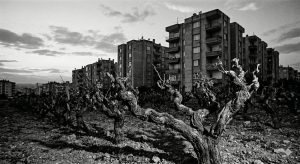
Pass through Misi Village in Bursa. Where lush vineyards once stretched as far as the eye could see, villas now rise. Look at the slopes of Tekirdağ; vineyards overlooking the sea have long been replaced by residential complexes marketed precisely for that same view. The story of how Paşaeli had to persuade a landowner not to uproot a near-century-old Semillon vineyard says enough on its own.
This insatiable creature we call urbanization sees land merely as a commodity measured in square meters. Yet once a vineyard is opened to construction, the soil is effectively sterilized. Land buried under concrete cannot breathe, and no matter how many centuries pass, it will never regain its former vitality.
As younger generations turn away from the hardships of vineyard life, these abandoned ancient vines are transformed into “valuable plots.” Human capital, perhaps, can be rebuilt. But land sealed under concrete is lost forever.
The Silent Cry of Indigenous Varieties
This is where the alarm reaches its most critical point.
Our vineyards do not merely produce “fruit.” Grapes like Papaskarası, Kolorko, Yapıncak, and Mazrona are the genetic memory of Anatolia. When the last generation that understands their language steps away, these varieties will survive only as biological data.
A vine may live for a hundred years. But without a human hand to tend it, prune it, and understand it, it becomes nothing more than wood.
The Keyboard and the Pruning Shears
Could a Hybrid Life Be the Answer?
So, is it possible to reverse this trajectory?
Telling a new generation to abandon the city entirely and retreat into rural isolation is not realistic. But it may be possible to remain connected through the vineyard.
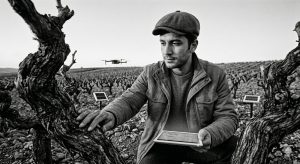
The viticulturist of the future cannot be defined solely as someone kneeling in the soil. They must become a “soil intellectual,” holding pruning shears in one hand and a tablet in the other, connected to the world while rooted in the land.
A hybrid model may offer a way forward. One that monitors soil moisture through sensors, analyzes data, and yet maintains a high-speed connection to the outside world from within the vineyard itself.
We could redefine the land, not as a burden, but as a domain of high craftsmanship, where small-scale and high-quality production thrives.
The real question is simple:
Will we actually do it?