
Robert Camuto is a writer whose work on the wine worlds of France and Italy I follow with genuine interest. In one of his recent pieces, he examines how the turbulent period that led Italy into fascism a century ago reshaped not only its wine industry but also its wine culture. Reading it, I realized that revisiting that era from a fresh perspective offers a powerful lens through which we can better understand the current landscape of Italian wine.
Camuto builds his narrative partly on the ideas of the Futurist movement of the 1920s. One of its notable figures, Umberto Notari, authored L’arte di bere (The Art of Drinking), a sharp, witty, and influential work that would later play a significant role in what came to be known as the Italian Wine Renaissance. This piece, however, steps back to take a broader view of Italy, offering a concise account of what unfolded in this pivotal wine nation—and perhaps prompting us to ask what lessons might be drawn for our own.
Italy Before Mussolini: In the Shadow of Migration and Poverty
On the eve of fascism’s rise, Italy was grappling with the lingering pains of unification (Risorgimento) and a deep economic crisis. Southern Italy (the Mezzogiorno), in particular, was mired in poverty due to the remnants of feudal structures and inefficient agricultural policies. For many Italians, “the land” had ceased to be a nurturing mother and had become a burden to escape.
Between 1880 and 1924, nearly 17 million Italians emigrated overseas—primarily to the United States—in one of the largest mass migrations in history. What they left behind were “villages without men,” neglected vineyards, and abandoned towns. Mussolini’s rhetoric of “returning to the land” and restoring “national pride” was built upon the trauma of these emptied landscapes.
An Ideological Bond with the Land: “Terre Italiane”
One of the ideological pillars of Mussolini’s regime was the glorification of rural life. Fascism positioned peasantry and attachment to the land as virtues in opposition to urbanization. In this framework, wine became a symbol of the Italian man’s strength, endurance, and ancestral roots reaching back to Ancient Rome.
The regime framed wine as “the blood of Italy,” embedding viticulture into the very fabric of Mediterranean identity. Yet this exaltation was less a product of rational agricultural policy and more a symbolic tool of propaganda.
The “Battle for Grain” and the Fate of Vineyards
In 1925, Mussolini launched the Battaglia del Grano (Battle for Grain), aiming to eliminate Italy’s dependence on foreign imports. The regime ordered that every available piece of land be used for cereal production. For Italian wine, this marked the beginning of a difficult chapter:
- Uprooted Vineyards: In many regions, high-quality vineyards were torn out to make way for wheat.
- Decline in Status: Wine lost its place as a refined pleasure of the elite and came to be associated with “alcoholism and moral decay” among the working class, while the bourgeoisie turned to foreign drinks like tea and cocktails.
The “Duce of Wine” and the Rehabilitation Campaign
At this point, Arturo Marescalchi stepped in, launching a large-scale campaign to restore wine’s reputation. Wine was rebranded as a hygienic, nutritious “national beverage.” Notable initiatives of this period included:
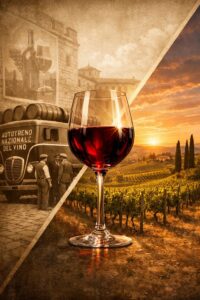
- The National Wine Train (Autotreno Nazionale): Launched in 1934 for the 12th anniversary of fascism, this “mobile wine shop” traveled across Italy, introducing standardized Italian wines to the public.
- Targeting Women: With the slogan bere all’italiana (“drinking the Italian way”), campaigns encouraged women to bring wine into domestic life—into living rooms and onto dining tables.
- Foundations of the DOC System: The 1924 regulation for the “Protection of Typical Wines” introduced regional controls (Chianti, Marsala, etc.) and producer consortia, laying the groundwork for today’s appellation system.
Guardians of Continuity: Holding History in the Glass
Amid these upheavals, certain families did more than survive—they preserved the very soul of Italian wine:
- Biondi-Santi: During World War II, as Allied and German forces clashed nearby, Tancredi Biondi-Santi famously sealed his cellar walls himself to protect precious old vintages—becoming a symbol of continuity.
- Antinori: With a lineage spanning 26 generations, the family endured Mussolini’s centralized system and later spearheaded the postwar “Super Tuscan” revolution that challenged rigid rules.
- Mastroberardino: While southern vineyards were uprooted during the “Battle for Grain,” this family remained committed to ancient varieties like Aglianico and Fiano, safeguarding Italy’s genetic heritage.
The Barolo Boys: A Rebellion Against Tradition
In the postwar period, the centralized rigidity of the system was shaken in the 1980s by the “Barolo Boys” movement in Piemonte. Elio Altare’s symbolic act of cutting his father’s old barrels with a chainsaw marked a radical break—transforming wine from a “museum relic” into a contemporary artistic expression.
Conclusion: Drinking the Sediment of History
If Italy today possesses one of the richest wine heritages in the world, it is not solely due to the generosity of its land. It is also the result of the immense meanings attributed to wine—even in the darkest periods of history.
The strict discipline of the Mussolini era, the economic struggles of the postwar years, and the rebellious spirit of Barolo all intertwined to create what we now recognize as the Italian wine miracle. Through Robert Camuto’s lens, one begins to see that a glass of Barolo carries not only the essence of the grape, but also the sediment of regimes and revolutions it has endured.
Looking at Italy’s past century, one cannot help but notice that even something as destructive as fascism inadvertently created opportunities for the wine culture and industry. The lands of Anatolia, on which our own country stands, once nurtured the ancestors of many Italian grape varieties.
If we are to move beyond our current, rather unfortunate position as a constrained wine country, all we need is a renewed perspective on the treasure we already possess. Positioning our wine is, in fact, quite simple. Our land is the very geography where wine was born.
Frankly, it’s hard to imagine a stronger argument than that.