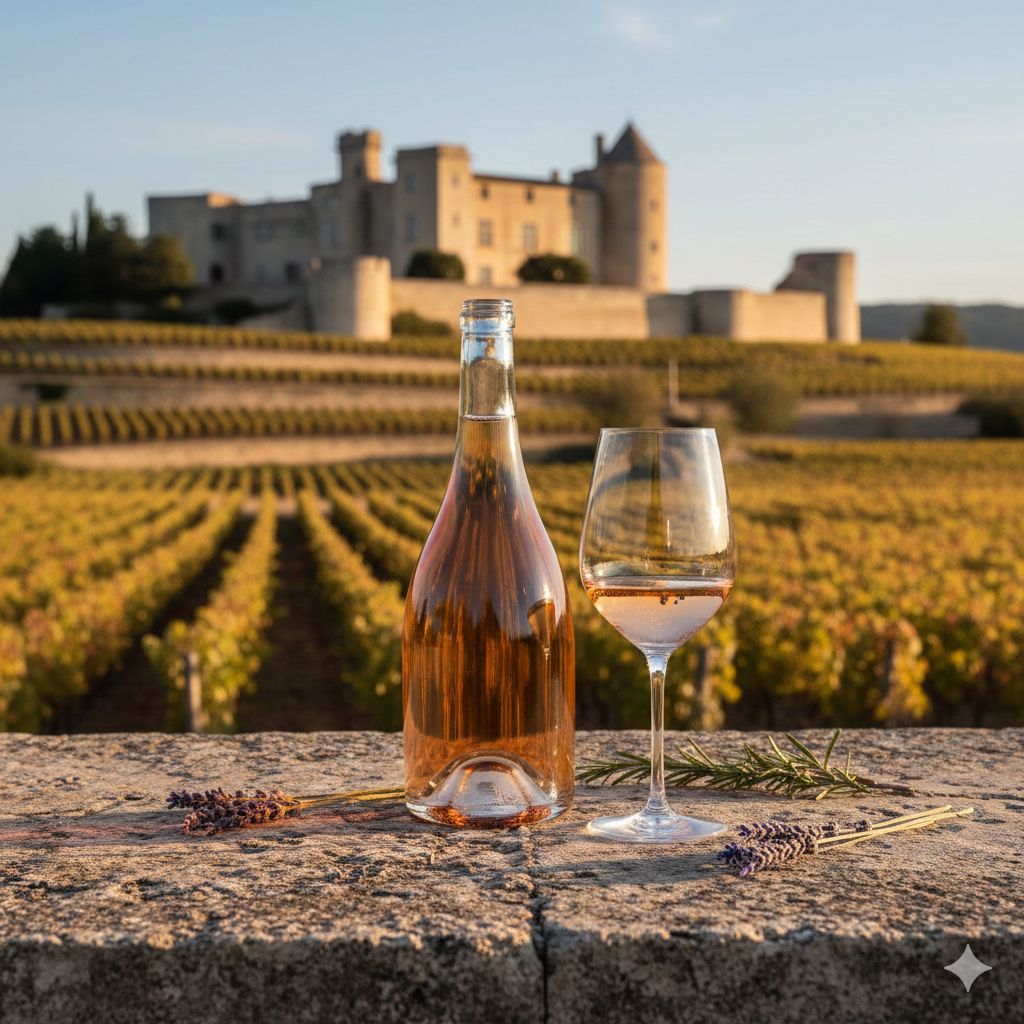
The story that stretches from the glittering lights of Hollywood to the quiet limestone vineyards of Provence is often dismissed as a mere “celebrity whim.” Château Miraval, however, stands as a striking counterexample that shatters this prejudice. The 500-hectare estate, first leased by Brad Pitt and Angelina Jolie in 2008 and later purchased in 2012 for approximately $60 million, represents far more than a simple property transaction. It can be seen as a turning point where the “celebrity” effect in the wine world converged with professional standards.
The Soul of a Castle and the “Brangelina” Vision
Miraval is not merely a collection of vineyards; it is a medieval château, a monastery dating back to the 13th century, and, above all, a hidden sanctuary of music history. During the 1970s, when it was owned by jazz pianist Jacques Loussier, a recording studio was established on the property that later hosted legendary names such as Pink Floyd—who recorded parts of The Wall there—as well as The Cure and Sade. When Pitt and Jolie acquired Miraval, they inherited not only the land, but also this rich cultural layer.
Brad Pitt’s obsessive passion for architecture and aesthetics became evident during the restoration process. Yet the real revolution began when the couple decided to position the estate not as a “hobby vineyard,” but as a serious enterprise aimed at producing the world’s finest rosé wine. At this point, a bridge needed to be built between Hollywood’s marketing power and the technical aristocracy of the wine world.
The Perrin Partnership: The Key to Technical Excellence
Brad Pitt understood that longevity in the wine world depends not on “fame,” but on “terroir” (the character of the land). With this in mind, they partnered with the Perrin family (Famille Perrin), owners of Château de Beaucastel and one of the most respected producers in the Rhône Valley. The Perrins were synonymous with “technical perfection” and “respect for tradition” in the wine industry.
The first rule of the partnership was clear: the Perrin family would have full control over vineyard management and winemaking, while Pitt and Jolie would shape the brand’s vision and aesthetics. The Perrins immediately implemented organic farming practices in the vineyards. All chemical fertilizers and pesticides were banned. Harvesting was done entirely by hand, and the grapes passed through sorting tables twice.
Technically, Miraval Rosé preserved Provence’s classic “light” profile while offering a surprising balance of body and minerality. While many rosé wines are produced using the “saignée” (bleeding) method—as a byproduct of red wine production—Miraval was crafted through a meticulous process in which the grapes were directly pressed and fermented in temperature-controlled stainless steel tanks. The result was a work of art on the palate, carrying notes of white flowers, fresh strawberries, and the saline minerality of Provence’s soils.
Wine Spectator and the “Sacred Seal of Approval”
When the 2012 vintage was released, Miraval’s first 6,000 bottles sold out online within just a few hours. Yet the true success lay not in sales figures, but in critical acclaim. The world’s most prestigious wine publication, Wine Spectator, included Miraval in its list of the “Top 100 Wines of the World.” This was an unprecedented achievement for a rosé wine at the time. Critics were captivated by the wine’s “depth.” This endorsement shattered the perception of “celebrity wine” and transformed Miraval into a symbol of prestige.
Economic Power and Unshakable Brand Value
When the divorce proceedings of the couple known as “Brangelina” erupted in 2016, financial circles grew concerned about Miraval’s future. However, the brand had evolved into an entity larger than the personal dramas of its creators. Miraval was no longer a “Pitt-Jolie wine”; it was simply “Miraval.”
By 2021, one of the world’s luxury giants, Moët Hennessy (LVMH),acquired Angelina Jolie’s shares, becoming a 50% partner in this empire. The transfer of a Hollywood star’s stake to the world’s largest luxury group stood as the most concrete proof of Miraval’s commercial success. Today, the estate’s total value is estimated to exceed $500 million—a remarkable multiplier effect achieved in roughly ten years from the initial $60 million investment.
Sociological Impact: The Renaissance of Rosé Wine
One of Miraval’s greatest contributions to the wine world was its role in changing the perception of rosé wine. Before Miraval, rosés were generally regarded as “cheap, refreshing summer drinks.” Miraval elevated the category to an “ultra-premium” level. Even the bottle design was revolutionary. The wide-based, elegant, rounded glass bottle—reminiscent of champagne bottles—stood on the table like a jewel. Thanks to Miraval, rosé became a lifestyle icon and a status symbol, ordered even in winter months at luxury restaurants.
Conclusion: The Anatomy of a Vision
The success of Château Miraval cannot be explained by fame alone. It is the result of the union of the right terroir, the right technical partner (the Perrins), and an unwavering aesthetic vision. Brad Pitt’s architectural passion and respect for the land transformed this project from a marketing exercise into a living legacy. Miraval continues to stand as the “gold standard” for all celebrity ventures that follow.
A short closing note is in order. In 2014, for BEPPE—our very first brand before WAYANA—we included the then newly emerging Miraval rosé in our inaugural wine menu. Among all the rosés we served, it was unquestionably the leader most deserving of praise. Oh, those were the days!