Dünyada olup bitenlere az çok aşina olan kime sorarsak soralım, şarap deyince akla gelen ilk ülke ezici bir hâkimiyetle Fransa olur. Yani Fransa şarap kültürünün tartışmasız lider ülkesidir.Fransızların şarapla olan birlikteliklerinin Anadolu’dan beslendiğini arkeolojik kayıtlar gösteriyor, ama bu başlığa sadece değinip geçiyoruz.
Fransa, Roma döneminden başlayarak bağcılık ve şarap üretiminin iki bin yılı aşkın bir süredir kesintisiz devam ettiği toprakların ülkesi. Hristiyan dininin kutsal bir önem atfettiği şarap, manastırların angajmanı ve himayesiyle asırlar boyunca yerini korudu. Böylece şarap Fransız gıda kodeksinin ayrılmaz bir parçası oldu. Bundan aldığı güçle de Fransa şarap kültürü, dünyanın arkasından gittiği bir merkez haline geldi.
The French managed to become the central reference point for global taste. The language of wine transformed into a glossary dominated almost entirely by French. Grand Cru, appellation, assemblage, bâtonnage… the fact that these terms gained universal acceptance is itself proof that France has long occupied the center of the wine world.
Fransa Neden Şarap Dünyasının Referans Ülkesi Oldu?
Bu süreci birkaç başlıktan oluşan bir bilgi kutusu olarak görmek işi kolaylaştırır:
Köklü bağcılık geleneği:
Yaklaşık iki bin yıllık üretim kültürü.
Teruar ve AOC sistemi:
Kökeni ve kaliteyi güvence altına alan kurumsal yapı.
Gastronomiyle bütünleşme:
Şarabın yemek kültürünün doğal parçası olması.
Bilgi üretimi:
Üniversiteler, araştırma enstitüleri ve meslek örgütleri.
Hikâye anlatıcılığı:
Bölge, üretici ve şarap kimliklerini küresel ölçekte markalaştırabilme.
Fransa’da Siyasetin Şarapla İlişkisi
In France, which wine a president chooses to serve has never been a simple personal preference. It has been interpreted as political messaging. De Gaulle’s fondness for Drappier, Pompidou’s devotion to Lafite, Hollande’s “normal president” persona supported by Muscadet, or Macron’s self-styled image as a “knowledgeable taster”… all of these reveal how wine functions as a form of cultural power at the state level.
Peki, Fransa’da halkın şarapla ilişkisi?
If we ignored the numbers and asked an outsider about the average French person’s relationship with wine, few would be surprised to hear “everyone drinks wine.” But the data tells a different story.
A century ago, in 1920, annual per-capita wine consumption in France was 140 liters. In other words, the average French person drank the equivalent of three glasses of wine per day. Today, that number has fallen to 22.5 liters per year, roughly one-third of a glass per day.
In mid-2025, Samuel Montgermont, President of Vin & Société, the French wine industry’s largest membership organization, stated that 6% of the French population consumes 55% of all wine. Nearly all of that 6% consists of elderly men. His point was stark: ten years from now, the demographic responsible for the bulk of French wine consumption will largely be gone. Unless France works urgently, the consumption deficit that follows will be dramatic.
How “Traditional” Is the French Wine Story?
The presence of wine in France goes back over 2000 years, but the idea that wine is the essence of French national identity is much more recent. It’s rarely mentioned that Burgundy supported beer production for centuries, or that Brittany has long held a deep cider tradition. Even the romantic notion of sending red wine to the front during World War I has been debated in terms of its real emotional or moral impact on soldiers.
The cultural dominance that France built through wine became part of its modern nation-building project. It shaped domestic and foreign politics alike: vineyard investments abroad, the integration of wine into haute cuisine, the transformation of “French taste,” and the near-total French influence on global wine vocabulary all served this narrative.
Phylloxera and Wine in the Colonies
When phylloxera devastated French vineyards in the 1860s, the wine shortage was compensated by what was then French Algeria, which became a major production hub. Now largely forgotten, Algeria became the world’s largest wine exporter in the 1930s, and its biggest customer was, unsurprisingly, France. Blind tastings often failed to distinguish Algerian wines from French ones, adding another twist to the story.
After French vineyards were replanted with American rootstocks and revived, and as winegrower unions in southern France gained strength, Algeria was increasingly portrayed as a producer of “low-quality” wine. Despite having supplied France for years, Algeria’s attempts to obtain appellation recognition went nowhere.
Stepping back, it becomes clear that the French tradition around wine is more complex and multi-layered than the neat national story often suggests.
What’s Happening in French Wine Today?
Vineyard Pullouts
In 2025, government-subsidized vineyard removals continued. The reasons are significant:
Oversupply:
France produces more wine than it can drink or sell. Controlled reduction of vineyard area has become necessary.
Climate Change:
New conditions render some vineyards unproductive.
Shifting Consumer Preferences:
Alternatives to wine are gaining popularity; red wine has suffered the most.
Shrinking Margins:
Small growers increasingly struggle to maintain sustainable profit margins.
Quality-Oriented Strategy:
Some regions are reducing volume to focus on higher-quality production.
Weakening of Appellations
Chateau Lafleur, an iconic producer in Pomerol, left its appellation, stating that existing rules no longer allow them to make the wines they envision. This signals a new era for France’s most sacrosanct system.
Climate Impacts Becoming Clearer
France announced that 2025 wine production would fall due to extreme heat. Concerns extend beyond quantity to quality.
Future Scenarios
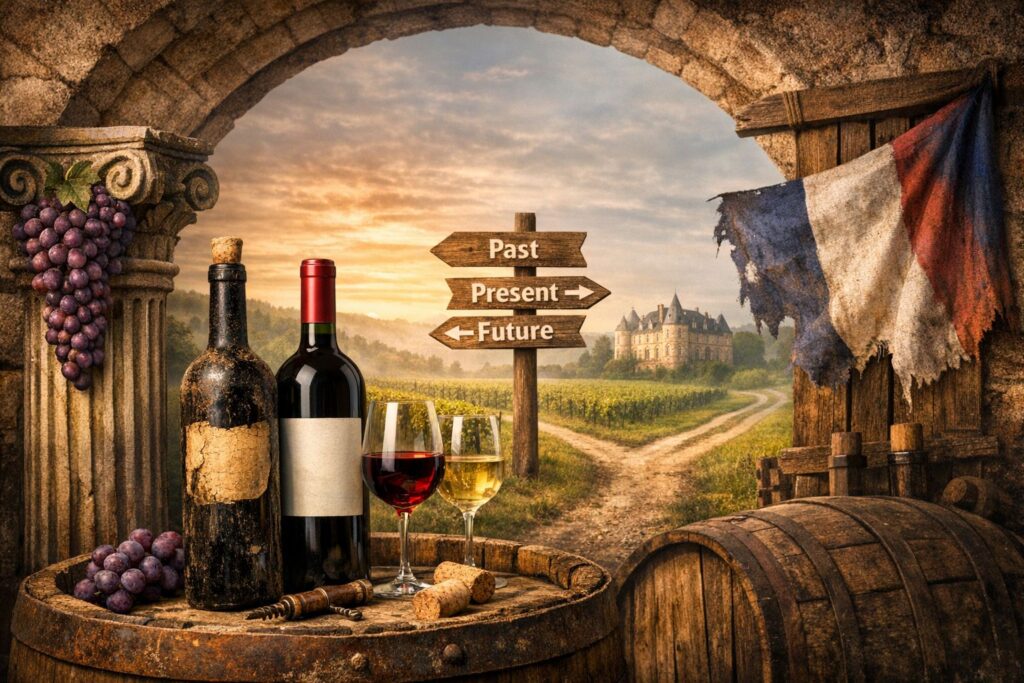
It seems unavoidable that France’s dominant role in the wine world will decline. England’s rise in sparkling wine is one of the signs. With per-capita consumption falling and expected to drop further, the domestic market will become increasingly difficult. Appellations, designed to protect quality, will either be restructured or see more producers break away.
Still, France has formidable cultural, academic, and technical know-how. This accumulated expertise will help the country maintain influence for quite some time.
But the heartbeat of wine appears to be shifting away from France.
In Essence
Topun yükselmesi nasıl sonsuza kadar devam edemiyorsa, şaraptaki yükseliş de Fransa için hep yükselemeyecek. Her ne kadar Fransa şarap kültürü tahtından indirilemeyecek olsa da, bakalım Fransız şarabı değişen koşullarla şekillenen yeni dönemde kendisi için yeni ve güçlü bir pozisyon yaratmayı başarabilecek mi?
Time will tell.
Bu yazımız ilginizi çektiyse, aşağıdaki yazılarımızın üzerlerine tıklayarak göz gezdirebilirsiniz.