To see wine merely as an aromatic liquid in the glass is to underestimate what may be humanity’s greatest biotechnological project. Wine is, in essence, a vast archive—one that has recorded the migration routes of societies, the evolution of trade networks, and the transformations of cultures over thousands of years. A recent study published in Nature Communications, based on genomic data extracted from ancient grape seeds, has opened the doors of this archive wide. Its findings do more than illuminate the history of viticulture in France; they provide scientific confirmation of how the true homeland of the vine—Anatolia and the Caucasus—has shaped Europe’s wine identity.
Anatolia’s Natural Heritage and the Wild Shores of France
The “ground zero” of winemaking stretches back to around 6000 BCE, across the South Caucasus and Eastern Anatolia (Upper Mesopotamia). The transformation of Vitis vinifera sylvestris (wild grapevine) into Vitis vinifera sativa (domesticated grapevine) through human selection stands as one of the most significant agricultural achievements of the Neolithic Revolution. Yet genomic data published by Ludovic Orlando and his team suggests that this heritage took considerable time to reach Western Europe.
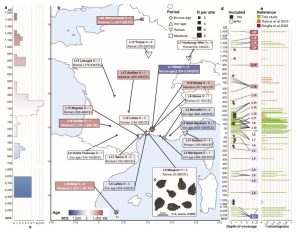
Bronze Age samples from France (2300–2000 BCE) show no trace of domesticated vines. The vines growing in Gaul at the time were not the ancestors of today’s French vineyards, but wild species that thrived naturally. The turning point arrives in the Iron Age (625–500 BCE). We now know—through DNA evidence—that the ships of the Phocaean sailors who founded Massalia (modern Marseille) carried more than olive oil and amphorae. They also transported the accumulated genetic library of the Aegean and Anatolia, cultivated over millennia.
The Vine Cutting as an Ancient Currency
One of the most striking findings of the study is the technological sophistication of ancient viticulture. Grape seeds discovered across different Iron Age archaeological sites were found to be genetically identical—clones. This indicates that vegetative propagation (cuttings) had already become a professional standard some 2,500 years ago.
When an exceptional vine was identified, ancient growers did not rely on seeds—leaving outcomes to genetic chance—but instead transported its exact genetic code across vast distances through cuttings. As the researchers suggest, these vine cuttings functioned almost like an “early form of currency.” This represents one of the greatest technological leaps in the scientific history of wine: humanity moved beyond merely observing nature, and began replicating desired flavor profiles, establishing a form of consistency that transcended both time and geography.
The Mystery of Reverse Migration: Furmint and Kolorko
When we look at the map of European viticulture, genetic flow is often assumed to move from East to West. Yet the story of the vine is rarely so linear. The relationship between Furmint—the legendary grape of the Tokaj region—and Kolorko offers a fascinating example of what might be called “reverse migration.”
Although Furmint is today regarded as one of Central Europe’s most prestigious white grapes, future genetic research may reveal it to be a “return migrant” of Anatolian origin. Morphological and genetic similarities with Kolorko point to how plant material may have moved historically along trade routes—from the Balkans to Anatolia, or in the opposite direction. As emphasized in our “Terra Anatolia Vinea” project, Anatolia is not merely a point of origin, but also a station where genetic variation circulating through Europe is reassembled and returns. This reverse flow reminds us that the vine does not belong to a single geography; it is part of a global cultural circulation.
Where Time Stands Still: Pinot Noir as a 500-Year-Old Clone
Perhaps the most poetic—and unsettling—finding of the study is that a grape seed discovered in Valenciennes (1400–1500 CE) is genetically identical to the Pinot Noir we drink today. As the French saying goes, plus ça change, plus c’est la même chose—the more things change, the more they remain the same. While France shifted from kingdoms to empires, from wars to revolutions, the silent genetic code in its vineyards has remained intact for over 500 years.
In this sense, agricultural continuity proves far more reliable than political history. A vine cutting pruned by a monk in the 15th century carries the same biological identity as the grapes entering modern stainless steel tanks today.
Conclusion: Terra Anatolia Vinea – In Search of the Source Code
The success of French viticulture lies not only in the opportunities offered by terroir, but in its ability—since the Iron Age—to preserve and refine genetic heritage arriving from elsewhere, particularly from Anatolia and the East. As we attempt to write the “scientific history of wine,” ancient DNA reminds us that the vine is a miracle shaped by human hands.
At WAYANA, we have an internal project we call “Terra Anatolia Vinea,” which we referenced earlier in this text. By looking back to the very origins of this genetic journey—where the vine was first domesticated—we are, in our own modest way, attempting to decode the source code of global wine culture. From Furmint to Pinot Noir, from Kolorko to the vineyards of ancient Gaul, this vast network reflects a shared memory—one that transcends borders, is enriched by migration, and preserved through genes.
The future will be shaped by how these ancient codes respond to climate change and shifting global conditions. And somewhere, in seeds we have not yet even noticed, the truths we hold today may already be preparing to change their form.