Power Plant Above, Vineyard Below
The dramatic effects of climate change are not something we notice overnight. It advances slowly, almost politely, easing us into what we begin to call the “new normal.” Only when we compare the world of our parents with that of our children and grandchildren do we fully grasp how severe the shift really is.
The most immediately visible sign of climate change is rising temperatures. In vineyards, this reveals itself clearly through shifting harvest dates and sunburn damage on grape berries caused by increasingly intense sunlight. Those who have lost hope in humanity’s ability to halt climate change are now turning toward solutions that make peace with new conditions instead. This article is devoted to one such project.
Hochschule Geisenheim University
Located in the heart of the vineyards of Germany’s Rheingau region, Hochschule Geisenheim University is an institution that has, from the outset, rejected the idea of being a “desk-bound academy.” It is regarded as one of Europe’s most competent research centers in viticulture, oenology, beverage technology, food science, and landscape architecture.This is an institutionalized community of people who refuse to settle for theory alone. They work in vineyards, cellars, and laboratories, and they take grapes seriously—especially Riesling, the local jewel of their region.
A Geisenheim Project: VitiVoltaic
The hybrid term vitivoltaic, formed from vitis vinifera and photovoltaics, serves as the umbrella name for this group of projects. The concept is built on a remarkably simple idea, and perhaps it is precisely this simplicity that gives it such a strong chance of success.
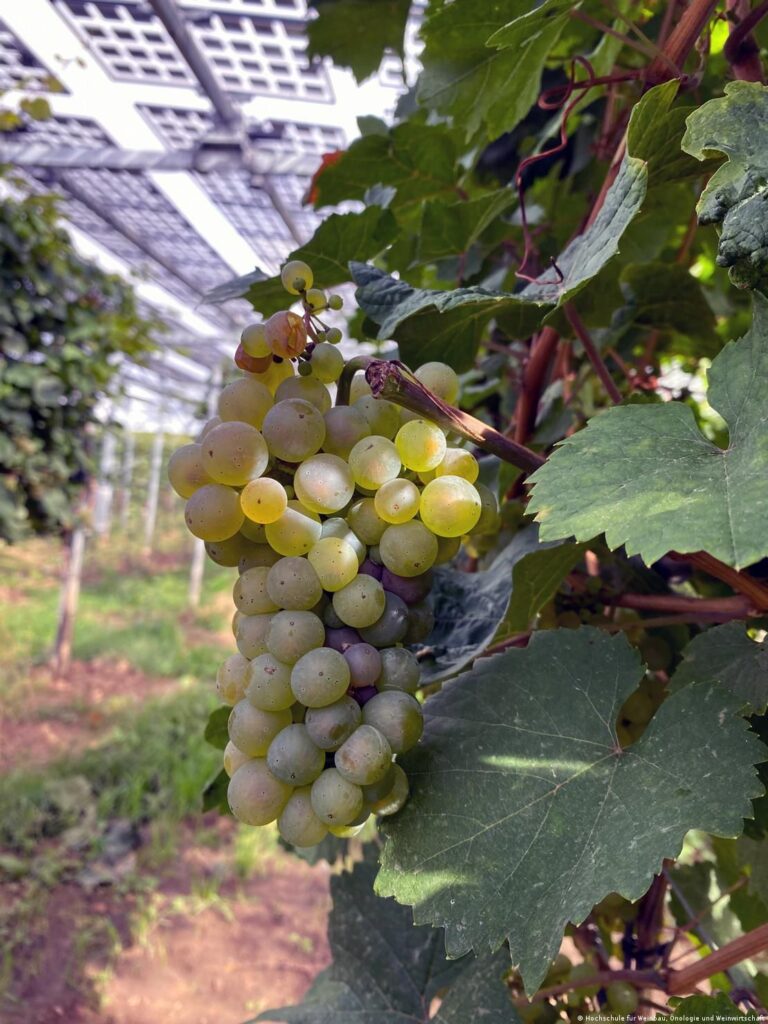
Researchers at Hochschule Geisenheim University have established a test facility to explore how Riesling, the region’s signature white grape, can be grown sustainably under climate change conditions with the help of photovoltaic (PV) panels.
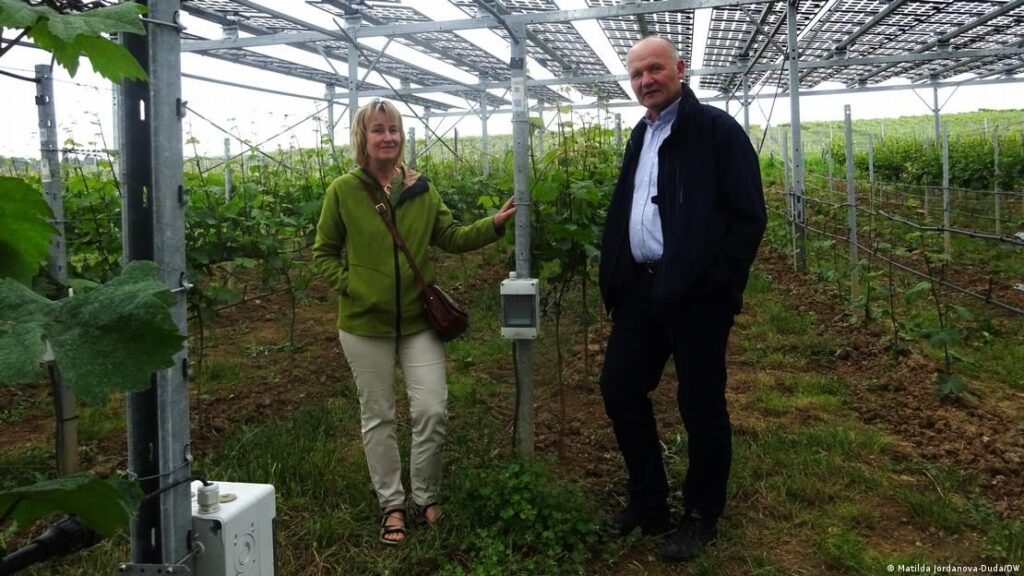
The panels are mounted at a considerable height, allowing vineyard work and agricultural machinery to operate comfortably underneath. This structure protects the sensitive vines from hail, heavy rainfall, and excessive solar radiation. On sunny days, the semi-transparent panels cast a checkerboard-like pattern of light and shade onto the ground. An automated tracking system continuously aligns the panels with the sun to maximize energy capture.
Riesling Under Threat
“Until now, we have never seen protected cultivation in viticulture,” says Manfred Stoll, Head of the Department of General and Organic Viticulture at HGU. Grapes are not grown in greenhouses or under plastic covers, which makes the passive protection provided by PV panels against hail and heavy rain a genuinely new approach.
Climate change, however, is putting Germany’s most popular grape variety under increasing pressure. Vines are now budding earlier and have become far more vulnerable to late frosts. Greater sun exposure raises sugar levels while acidity declines, altering both alcohol levels and the overall taste profile of the wines. So far, two vintages of what the university informally calls “watt wine” have been produced. These Rieslings display a lighter, more fruit-driven character reminiscent of earlier decades.
Heating Cables Against Frost
Within the scope of the project, HGU has also gained valuable experience with vineyard microclimates. The experimental facility, funded by EU and state grants and costing approximately €350,000, is equipped with numerous sensors that measure soil moisture, temperature, and light levels.
While no sunburn or heavy rain damage has been observed in the vines beneath the panels, the adjacent control plot suffered significant losses. Heating cables and drip irrigation lines were installed along the vine rows. The heating system proved its worth during a three-night late frost event in April 2024. At that time, extremely fragile shoots measuring about 10 cm were protected by cables powered by stored green electricity. Stoll notes that growers traditionally light large candles during such frost events, a method that is labor-intensive and produces heavy smoke pollution.
The electricity generated is also used to operate the facility itself, charge agricultural machinery, cars, and e-bikes, and power pumps as well as an autonomous tracked robot responsible for soil cultivation, ground cover management, and plant protection treatments.
“A winery needs energy year-round for production, storage, and logistics,” Stoll emphasizes.
VitiVoltaic technology stands out at a time when the wine sector is grappling with multiple challenges. In some regions, harvests are weak; elsewhere, shifting consumer habits, tariffs, and oversupply are putting pressure on global markets. Although electricity generation could provide vineyards with a second source of income, securing sufficient investment capital remains a major obstacle.
Last year, a much smaller and mobile PV system was also installed in Geisenheim. Attached like an awning to existing vine posts, these panels can be automatically retracted with a small motor in the event of storms or hail. While more affordable, this system offers limited protection and electricity production. Nevertheless, HGU continues its trials in search of the most viable solutions. As Stoll puts it plainly: “We definitely don’t have time to wait anymore.”
Abandoned Vineyards
Engineer and amateur winegrower Christoph Vollmer is another practitioner working with photovoltaic systems. In his small vineyard in Oberkirch, southwest of Stuttgart, agricultural machinery is difficult to use due to steep slopes exceeding 30 percent, some of which are terraced.
As Managing Director of Intech Clean Energy GmbH, a family-owned company specializing in agrivoltaic systems, Vollmer has developed a custom design for such steep terrain, suspending glass panels from steel cables. He is now installing this system in his own vineyard.
The young grower plans to plant two hectares under solar panels with disease-resistant grape varieties and aims to produce approximately 1.5 megawatt-hours of electricity annually. Contract negotiations with municipal energy providers are ongoing, and he also plans to charge an autonomous tracked tractor to ease labor-intensive work on the slopes.
Installing photovoltaic systems on steep inclines is technically more demanding, Vollmer admits, but for an engineer, it is also an exciting challenge. More importantly, he sees it as a necessary step. Slopes once considered ideal for viticulture are now losing their advantage as global warming makes flatter plains in Germany increasingly viable.
“Many vineyards have already been abandoned simply because no one wants to work them anymore,” says Vollmer, adding that rising minimum wages could accelerate this trend by further squeezing growers’ margins. Yet vineyard-covered slopes are an integral part of the cultural landscape, a key tourist attraction, and vital for biodiversity.
The Beauty of the Project
A Solution to Sunburn, Frost, Hail, and Rain — While Producing Your Own Electricity
The VitiVoltaic project is exciting even on the page. It is hard not to admire its multifaceted ability to address nearly all of viticulture’s natural threats at once. How far will it go in the wine world? Will financing solutions emerge to bring this technology fully into practice? That, for now, remains the open question.