Whenever I come across a new wine book and begin writing a review, I usually start by saying just how barren our publishing scene is when it comes to this subject. But even deserts have cacti — so from time to time, a rare gem appears in our arid landscape, and when it does, it shines all the more brightly. Maybe it’s because there are so few, but the excitement they stir in us is enormous.
It’s undeniably brave of TUDEM Publishing to put out a book with wine in the title. WAYANA was founded to bring local grapes and wines to broader audiences. Aside from wine, we only serve water, soda, grape juice, and hardaliye. And if you glance at our social media pages, you’ll notice that the word wine is nowhere to be found. That’s the irony — a place entirely dedicated to wine can’t even mention it in its posts.
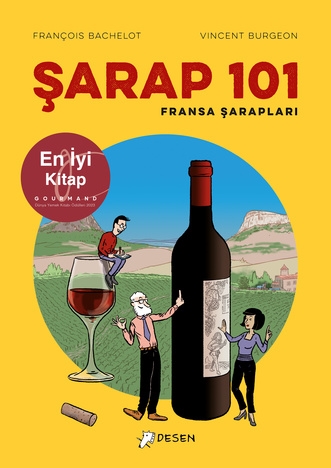
Now, Let’s Talk About Wine 101
A graphic novel requires the seamless collaboration of two distinct art forms. Ideally, the creators are skilled in their respective crafts and can understand each other without needing to say much. Looking at this particular work, even if we know nothing about how it came together, the result is clearly the product of a competent and balanced effort. Sure, we approached it with a kind of “friendly bias.” But even if we hadn’t, the book would still deserve recognition on its own merits.
At the beginning of the book, we see François Bachelot credited for the script and dialogue, and Vincent Burgeon for illustration, coloring, and layout. The story structure and storyboard appear to be a joint effort — no surprise there, given how much creative brainstorming must have gone into it.
The Characters
On the opening page, we meet the three protagonists of the story:
JEAN: – One of the original members of the BAKANALE Agency. Owner of an impressive wine cellar and an encyclopedic knowledge of wine. Currently the agency’s sales director.
LUCIEN: – The agency’s art director. Passionate about food and cycling.
CHARLOTTE: The agency’s copywriter and editor. Loves wine in all its forms and understands it deeply.
The Flow of the Book
The story unfolds as Jean, the seasoned wine enthusiast, guides Lucien through the journey of wine over the course of 24 days spread across a year — from vineyard to glass. Each of these “days” serves as a chapter focusing on a specific aspect of wine. Much like many wine lovers who feel a bit lost in the vastness of it all, Lucien embarks on this journey with uncertainty. But thanks to Jean’s patient and generous guidance, he begins to find his footing right from the first day.
The book imparts essential knowledge in a humble and accessible way. There’s not a hint of the snobbery or elitism that too often creeps into wine culture. Instead, the tone remains warm and friendly throughout — and with the help of the graphic novel format, the material becomes even more digestible.
The Chapters
The book opens with a gentle introduction: the distinction between sparkling/still and dry/sweet wines. It then builds on a film metaphor: the grape as the actor, the terroir as the atmosphere, the vintage as the script, and the winemaker as the director. This framework helps Lucien form a mental map of the world of wine.
Since the book focuses on French wine, each chapter is tied to a specific French wine region. The first stop is Chablis, on February 21 — a natural way to introduce the Chardonnay grape.
The following section dives into aromas and flavors through food pairings, exploring both sensory perception and the idea of balance. Then comes a visit to the agricultural fair, which ties into a segment on Sancerre and Sauvignon Blanc.
The Bordeaux chapter covers red winemaking, Cabernet Sauvignon, Merlot, and the iconic Right Bank/Left Bank division. The Sauternes section explains noble rot, sweetness, and the role of yeast.
The journey to Savoie introduces both the Mondeuse grape and the concept of blind tasting. In Champagne, we explore sparkling wine production and the sweetness scale, from brut to doux. Here, we also learn about the logic behind wine sequencing and tasting order.
When discussing Southwest France, the book briefly covers the phylloxera crisis and grape classification, highlighting Malbec, Tannat, and Manseng. Provence and the Mourvèdre grape serve as the backdrop for a look at rosé wine.
Late July brings a trip to the Loire and Rhône valleys, where we meet Chenin Blanc, Cabernet Franc, and Grenache.
By now, it’s harvest season. We’re in Languedoc, learning about Carignan. The next chapter takes us to a wine fair, where we get a crash course on wine’s life cycle and how to read a label. We then learn about wine cellars, decanting, and aeration.
The Burgundy section introduces the concept of appellations and cru classifications. Come November, the focus shifts to Beaujolais and the Gamay grape. A Christmas celebration sets the stage for a chapter on naturally sweet wines and the Alsace trio: Riesling, Gewürztraminer, and Muscat.
In January, we dive into organic, biodynamic, and natural wines — along with Syrah and Viognier. As we approach the end, the Jura region offers a look at the ancient Savagnin grape and various sweet wine techniques tied to seasonal cycles. The penultimate chapter, “It’s a Matter of Style,” explores how regional and stylistic distinctions shape both red and white wines across France, and how these connect to food pairing principles. Finally, the book wraps up with a wedding banquet — a celebration of wine and food coming together in perfect harmony.
A FINAL WORD
This 144-page book reads quickly — but it’s no Batman comic. The content deserves to be savored slowly, and readers will likely find themselves returning to it again and again. And the book earns that kind of attention.
So here’s a heartfelt thank-you to everyone who wrote, drew, published, translated, and contributed to this project in any way.
And of course, one last wish to tie it all together:
May Turkish wines be next.