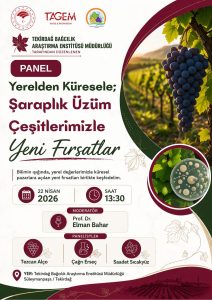
On April 22, 2026, we had the opportunity to attend a panel organized by the Tekirdağ Viticulture Research Institute. We had previously written about the Institute. It carries the responsibility of a task of great importance for our country. The entire inventory of our nation’s vine genetic resources is held there, and all of it is preserved within their collection vineyards. To put this into perspective with a number: a total of 1,459 grape varieties are cultivated and studied at this institution.
Once we heard about the panel, we rearranged our schedule and set aside April 22 for Tekirdağ. One of the day’s unexpected bonuses was a stop for Tekirdağ köfte along the way. For that alone, we owe the organizers an additional note of thanks.
Who Was on the Panel?
We should begin with the moderator. One of the most senior figures in the field, Prof. Elman Bahar opened the session with a warm introduction, greeting nearly everyone in the room by name. It is worth noting that Professor Bahar has a career spanning nearly forty years. This period essentially covers the entire era in which the wine sector in Turkey began to find its footing. He and the students he has trained have laid the foundations for where wine in Turkey can go. Because the path to good wine, inevitably, passes through science.
The speakers we listened to were highly experienced experts working within the Tekirdağ Viticulture Research Institute. We can summarize their contributions as follows:
Saadet Sıcakyüz brought us up to date on a topic that can no longer be denied: the climate crisis. Her talk addressed types of drought, their effects on ecosystems and plant life, and both current and projected impacts globally and in our own geography. The Institute’s long-term meteorological records allowed us to observe, in numerical terms, the changes of the past twenty years. This picture also reminds us that grapes, which have been cultivated on these lands for over 11,000 years, must be reconsidered from a new perspective in terms of climate resilience. In short, the picture she drew was exhausting. But it reminded us, once again, that reality is not something we can avoid.
Our second speaker was Tezcan Alço, one of the Institute’s most senior experts and a figure whose life has been spent in the vineyards. He introduced us to local grape varieties—nearly forty in number—that have been identified through years of research, varieties we are largely unaware of but which may hold real potential for the future of wine. We learned that five of these varieties have completed their official registration processes and are now ready for propagation. Naturally, we are pleased about these five. But the question is obvious: what about the remaining thirty-five? It would be unfair to expect a full answer from Alço alone. Yet accelerating the process for these long-neglected grapes could very well lead us to varieties with characteristics even more compelling than those already identified. At this point, the support and motivation of industry stakeholders for Alço and his team become critical.
Finally, the presentation by Çağrı Erseç on wine yeast research was particularly exciting. The results of their work with Papaskarası grapes collected from different vineyards offered real hope for the development of native yeasts. It is worth underlining one point here: the greatest risk posed by industrial yeasts is their tendency to standardize wines, flattening them into uniform products. If Erseç’s project comes to fruition, it would mean that the genetic identity of our own grapes could finally carry our true story into our wines. On this occasion, we were also reminded of the significant efforts previously made by Prof. Neşe Bilgin at Boğaziçi University—highly successful work that unfortunately never reached commercialization. Hopefully, this time we can produce a solution that allows our producers access to yeasts that truly reflect our terroir.
Wine producers and growers from Thrace showed strong interest in the panel. Alp Törüner from Büyülübağ, Mustafa Çamlıca from Chamlija, Muaffak Özdil from Ellez, Nazan Başol from Nuzun, and Metin Harbialioğlu from Prius all contributed to the discussion with their questions and remarks.
Final Thoughts
The Tekirdağ Viticulture Research Institute is the institution with the most substantial accumulation of knowledge in viticulture and winemaking in Turkey. It operates on a budget allocated by the state. The building in which the panel we attended was held was added to the Institute just last year. It is not difficult to imagine the effort required to construct such facilities, and to equip laboratories with the high-cost technology necessary to keep pace with scientific development.
Under these conditions, we owe thanks to the Institute’s Director, Mehmet Ali Kiracı, for sustaining this work. Guiding these efforts with a clear sense of purpose, securing resources, and, perhaps most importantly, managing such a team in harmony, is a significant service to a sector that our country still approaches with caution. On this occasion, we extend our gratitude to the entire team of the Tekirdağ Viticulture Research Institute, in the person of Mr. Kiracı.