The idea behind the TANEANDA tasting planned for 7 December 2025 came from Göknur Gündoğan. The purpose of the event was to give Metin İlhan, whose work has shaped a significant portion of the vineyards in our country, the chance to share his experiences with enthusiasts and to highlight the philosophy behind the new-generation vines he cultivates in his own vineyards.
Göknur’s suggestion made perfect sense for us. It offered the chance to hear, directly from the most competent voices in the field, topics we often touch on: PiWi grapes, academic research on vines, and the broader conversation around innovation in viticulture. It was also an opportunity to draw attention to this field.
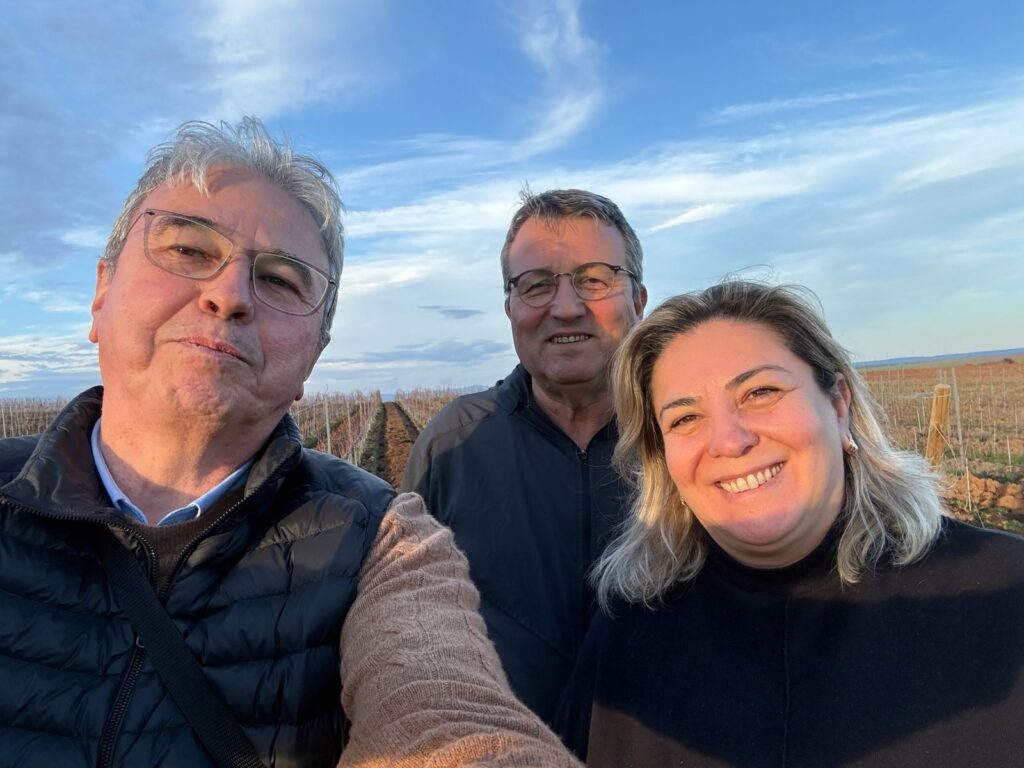
To make this process more meaningful, we visited Kırklareli as guests of the couple behind Taneanda, Hanife and Metin. We listened to their story right at the edge of their vineyards. And to leave out the part where we shared a roasted kid beforehand would be to tell the story incompletely.
A Brief Journey Through the Vine’s Story
It is estimated that the transformation of wild grapevines into cultivated vines began 10–11 thousand years ago. There is one major difference between wild and cultivated grapes: wild vines exist as separate male and female plants and reproduce only through pollination, which limits fruiting to particular conditions. Yet nature, with its usual mischief, occasionally causes mutations that allow male and female flowers to appear on the same plant. Our ancestors selected these rare individuals, laying the foundations of viticulture.
For thousands of years, new hybrid varieties have emerged through natural crossbreeding. The deliberate creation of new varieties by humans accelerated dramatically with the phylloxera disaster. The old-generation hybrids produced through 19th-century breeding programs are now almost entirely gone.
Hybridization has historically met strong resistance in the wine world. Technical concerns played a role, but so did the reluctance of European growers to open their borders to unfamiliar varieties.
Since the 1960s, however, modern breeding techniques have transformed the debate. Today, improving vine quality is widely accepted, and hybridization generally falls into two categories:
- Quality-oriented breeding
- Disease-resistant breeding (PiWi)
Quality-Oriented Breeding
This approach prioritizes not the vine, but the wine itself. The goal is better drinkability and more expressive aroma profiles. It focuses on enhancing the grape’s character: color intensity, acidity, aromatic diversity, ripening performance, yield stability, heat tolerance. The varieties used belong to the Old World family, Vitis vinifera.
Several well-known grapes emerged from this work:
Pinot Noir × Cinsault → Pinotage
Balufrankisch x St. Laurent → Zweigelt
Riesling x Trollinger → Kerner
Riesling x Madeleine Royale → Müller-Thurgau
Disease-Resistant Breeding (PiWi)
Here, survival takes precedence. The goals include resistance to fungal diseases, reduced need for fungicides, lower production costs, compatibility with organic farming, drought and heat resistance, and suitability for sustainable agriculture. The aim is not simply to produce a tastier wine, but to cultivate healthier vines requiring minimal spraying.
PiWi breeding uses both Vitis vinifera and American vine families. Examples include Floreal, Regent, Cabernet Blanc, Muscaris, and Vidoc.
The Taneanda Tasting
Our WAYANA tasting featured both styles: Caladoc, born from quality-oriented breeding, and Floreal, a true PiWi variety.
Caladoc emerged in the 1950s through Paul Truel’s work, crossing Grenache and Malbec. It is a modern hybrid, but not a PiWi. It offers impressive heat and disease tolerance while delivering remarkable color and aroma.
Floreal, on the other hand, is a textbook PiWi: developed at the INRA centre in France and officially recognized in 2018. It is exceptionally disease-resistant, requires almost no spraying, and is highly suited to organic farming. Clean, fruity, lightly floral, and incredibly successful in warm regions. In short, a perfect match for the Turkish climate.
During the tasting, we explored Caladoc through a vertical flight reaching back to 2007. Even the older examples retained their elegance. Floreal, being a white variety meant for young consumption, is not suited to vertical tastings, yet its vivid fruit and floral notes surprised and delighted everyone.
A Few Words About the Producer
Metin İlhan is a name that carries immense influence in Turkey’s wine-grape vineyards. His use of modern techniques and the functional, innovative solutions he has developed reveal a distinctive approach. It doesn’t take long to see how much simple, practical interventions can improve both vineyard efficiency and the daily life of those working the vines.
Naturally, a producer with this mindset also makes unconventional choices in grape selection. At every fair he attends religiously, he seeks out varieties with limited presence today but strong potential for tomorrow. Caladoc, Marselan, Floreal — they all fall into this category.
Floreal has an additional twist: before France restricted the international sale of its young vine stock, Metin İlhan managed to bring Floreal vines into Turkey. As a result, only two countries in the world currently grow and vinify Floreal: France and Turkey.
At Taneanda, grapes are processed in the wineries they provide vineyard services for. The vines are Metin Bey’s domain; the operational processes fall under Hanife Hanım’s expertise. They clearly do not operate with volume as a priority. But they are absolutely worth knowing, and the wines they produce are worth tasting.
In Essence
We thank Göknur Gündoğan for sparking this tasting. And we congratulate Hanife and Metin for choosing this alternative path and introducing us to their way of thinking.
In the coming years, the effects of changing climate conditions will intensify. Let’s see what new-generation vines and grape varieties will show us next.