To do justice to WAYANA’s “Producers at WAYANA” series, we set ourselves a clear task: if we are to present a guest producer properly to our wine-loving audience, we must visit their winery and vineyards, and experience the place—if only briefly.
As part of this commitment, we visited Arcadia, our guest for April 2026. As we were leaving, picking up the samples Zeynep Arca, representing the family behind Arcadia, had prepared for us, a book on the shelf caught my eye—one I had never seen before. My first reaction was embarrassment. In a country where almost no wine books are published, missing one that already exists felt like a failure on my part, as if I hadn’t done my homework well enough.
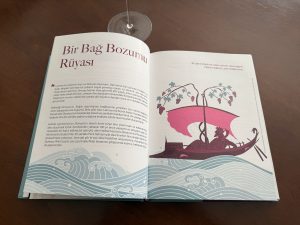
Sensing my mild frustration, Zeynep Arca explained that it had only recently been published and immediately handed me a copy. She didn’t even insist on payment—I walked away as a book owner. That is how Gürcan Vural’s book found its way into our hands.
In recent years, increasingly restrictive regulations on alcoholic beverages have dealt perhaps their most significant blow not to consumption, but to wine as a cultural domain. Anyone wishing to produce content on wine now faces added concerns—not only about publishing, but also about distribution. The vague and ever-threatening notion of “encouraging alcohol consumption,” along with the risk of heavy fines, creates a climate of hesitation.
This is precisely why we launched WAYANA’s “Books with Wine Between the Lines” series—and we intend to keep it alive for as long as we can.
Now, to Gürcan Vural’s work, which might best be described as a life story enriched—almost shaped—by wine. Wine is, in every sense, a deeply personal experience. Just as our fingerprints or retinas are unique, so too are our palates. And all wine experiences draw their meaning from this individuality.
If you make as much space for wine in your life as Vural has, you will inevitably accumulate a rich and personal body of experience. But turning that into a book is something few manage to do. Gürcan Vural has.
The book consists of 32 chapters—excluding the introductory and concluding sections. A glance at the titles reveals a series of observations and reflections on terroir, largely shaped through encounters with Turkish producers. The book clearly does not aim to function as a guide. Instead, it follows the author’s palate—his personal compass—moving from one experience to another, recording those journeys as they unfolded.
Reducing wine to its technical aspects is an easy trap to fall into. Vural avoids it. In a time when individuals are becoming increasingly isolated within society, wine—once one of the simplest and most meaningful tools of social connection—seems to be losing that role. The friendships documented in the book, along with the portraits of lesser-known figures in the wine world, push back against this erosion and bring a quiet warmth to the pages.
Naturally, the book also makes room for wine regions that have managed to organize themselves far better than we have—and to make that organization widely accepted. And, as expected, the indispensable companions of wine—tables and food—appear throughout the book, sometimes as dedicated chapters, but more often woven seamlessly into nearly every section.
This is not a conventional book review. It is, rather, a reminder from one wine lover to another: to notice the traces left behind by a life colored by wine. We congratulate and thank Gürcan Vural for creating this remarkable work—one that brings color and energy to the otherwise constrained wine landscape of our country—and for having the courage to publish it, fully aware that it would likely never bring financial reward.