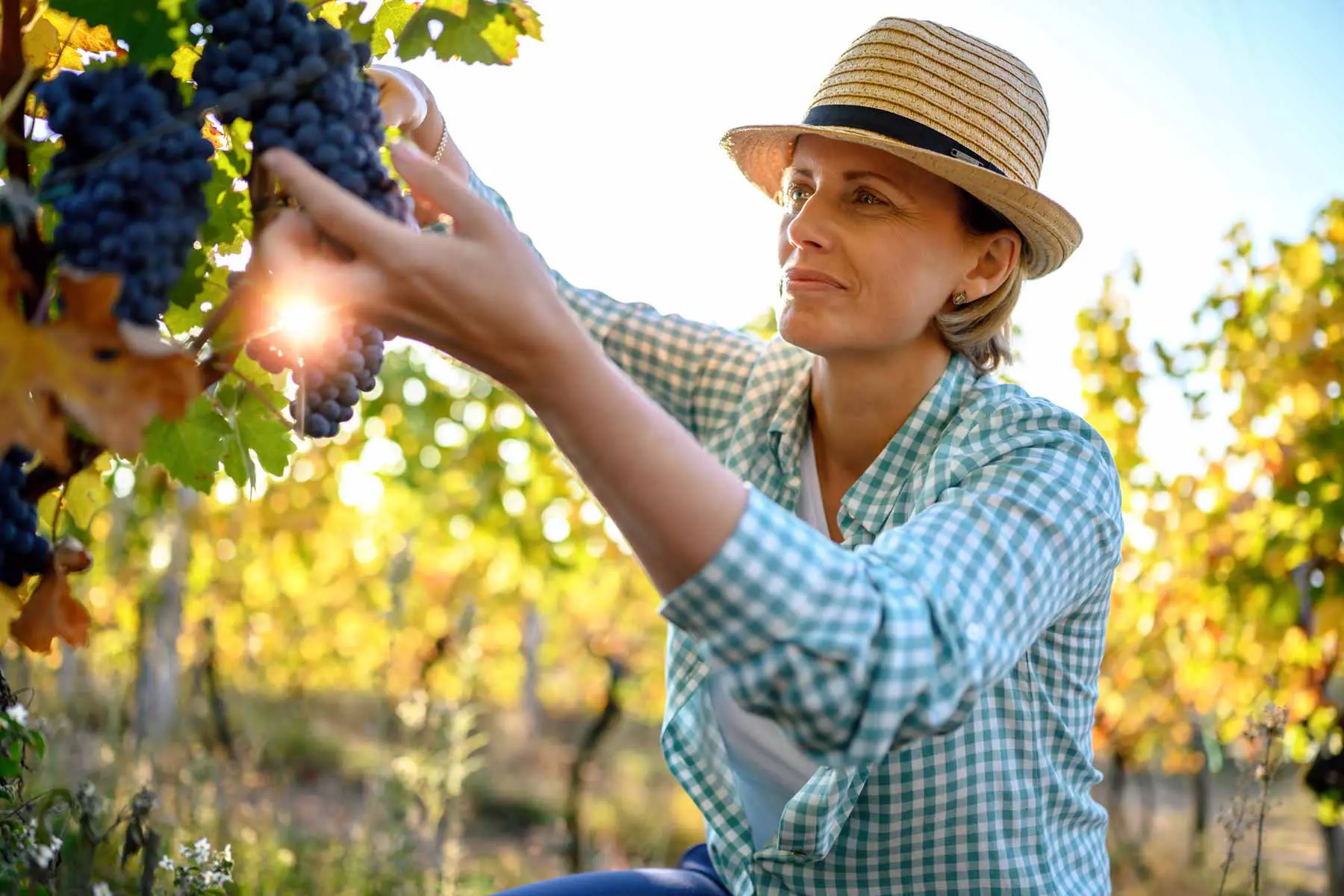
Kanarya Adaları, Avrupa turizminin en istikrarlı başarı hikâyelerinden biri. Ama bu hikâyede Kanarya Adaları şarap turizminin henüz bir payı yok. Yılın on iki ayı güneş, ılıman iklim, güçlü ulaşım ağı ve oturmuş konaklama altyapısı… Kuzey Avrupalı turistler için “kış bahçesi” işlevi gören bu takımadalar, on yıllardır milyonlarca ziyaretçiyi ağırlıyor. Sayılar parlak, oteller dolu, uçaklar sürekli inip kalkıyor. Fakat son yıllarda adalarda giderek daha sık sorulan bir soru var: Bu kadar çok turist, gerçekten yeterince değer üretiyor mu?
Today, the issue facing the Canary Islands is not growth in tourism but the creation of meaning and added value. The search is to be not only a place that is “visited,” but also one that is “told.” At the center of this search are two elements that are becoming increasingly visible: wine and gastronomy.
Milyonlarca turist çeken bir destinasyon neden artık yalnızca güneşini ve plajlarını değil, şarabını da anlatmaya çalışıyor? Bunun cevabı, günümüz turizm anlayışındaki köklü değişimde saklı.
A Story That Begins with the Sun
The modern tourism adventure of the Canary Islands begins in the 1960s. As Spain made tourism a strategic priority as a sector that would generate foreign currency, the Canaries became a natural attraction center: mild weather even in winter, long beaches, proximity to Europe, and low costs. The model of this period was clear: mass tourism, package tours, and “all-inclusive” hotels.
From the 1990s onward, the islands became one of Europe’s most well-known holiday destinations. Millions of tourists arrive every year, primarily from Germany, the United Kingdom, and Scandinavian countries. In the 2000s, visitor numbers settled in the 14–15 million range; tourism became the backbone of the regional economy. A large share of employment and income depends on this sector.
But there is a shadow behind this success story. Despite high visitor numbers, per capita spending remains relatively low. Large hotel chains, closed-circuit resorts, and the package tour logic limit contact with local production and culture. In short: many tourists, but limited depth.
Post-Pandemic Awakening
The 2020–2021 period caused a rupture worldwide, and the Canary Islands were among the places most affected. With the pandemic, tourist numbers dropped dramatically; how fragile excessive dependence on a single sector can be became clearly visible. This shock brought a long-postponed question to the forefront: “Don’t we have another story in tourism?”
In recent years, the response has been to define the islands not only as a beach destination, but through experience, nature, culture, gastronomy, and wine. The goal is not to break away from mass tourism, but to complement it with a more qualified layer: fewer but more engaged visitors, higher added value, and a stronger identity.
One of the most intriguing pillars of this transformation is viticulture and wine.
Yeni Yön: Kanarya Adaları Şarap Turizmi
For a long time, gastronomy remained in the background of tourism in the Canary Islands. Hotel kitchens and international menus took precedence over local products. Yet the islands possess an extremely distinctive production heritage, from fish to cheese, from vegetables grown in volcanic soil to local grape varieties.
Today, the following concepts are mentioned more frequently in tourism strategies: “slow tourism,” local producers, rural accommodation, gastronomic routes, volcanic heritage. Wine stands out as one of the strongest carriers of this new narrative. Because Canary wines are not only “delicious”; they are products that tell the geography itself.
Viticulture on Volcanoes: Technical Challenges
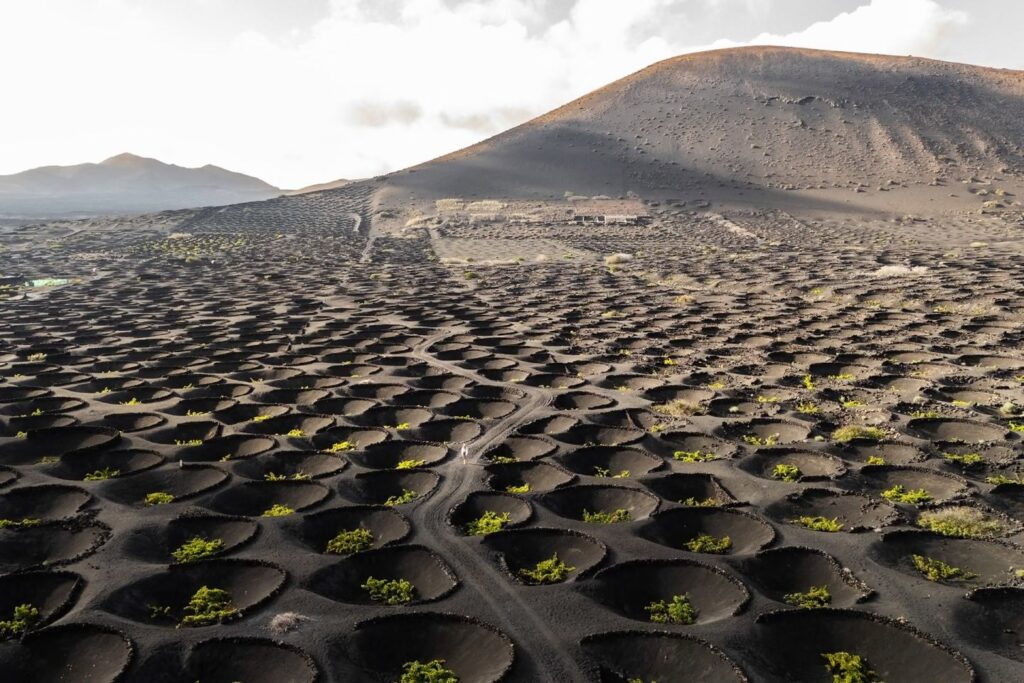
Viticulture in the Canary Islands is quite different from the familiar vineyard landscapes of Europe. Especially in Lanzarote, vineyards consist of individual vines planted one by one inside volcanic craters. The grapes grow under volcanic ash known as “picón.” This ash layer retains the islands’ extremely limited moisture and supports the vine by slowly releasing the heat absorbed by the soil during the day at night.
However, this method also makes mechanization almost impossible. There is no space for tractors; pruning, vineyard maintenance, and harvesting are carried out entirely by hand. Due to strong winds, stone walls are built around the vines. These walls are constructed without cement, by stacking stones one on top of another, and require maintenance every year.
Behind the romantic photographs lies an extremely difficult mode of production. Canary viticulture is not so much a “boutique production choice” as it is a necessity imposed by geography.
An Isolated Gene Pool: Grape Varieties
Another uniqueness of the islands lies in their grape varieties. The Canary Islands remained largely isolated during the phylloxera disaster that ravaged Europe; as a result, many vineyards have continued to live ungrafted, on their own roots. This situation, which has almost disappeared in modern viticulture, makes Canary vineyards genetically unique as well.
Among the main local varieties are Listán Negro, Malvasía Volcánica, Diego, and Listán Blanco. These grapes grow in volcanic soil, under strong winds, with limited water, giving the wines a pronounced minerality, lively acidity, and a distinctive character. Production volumes are low; but the resulting wines carry an identity that cannot easily be found anywhere else.
At this point, wine is not merely a beverage; it is like the liquid form of the islands’ biological and cultural memory.
Economic Tension: Passion or Sustainability?
All this uniqueness, however, creates serious economic tension. Production is extremely labor-intensive; parcels are small; climate change has made yields unpredictable. Many producers do not hesitate to say, “If we did this at its true cost, we could not survive.” Wine is often sustained as a passion-driven production rather than a commercial activity.
Tourism increases the visibility of wine; visitors tour vineyards, taste wines, and order a few bottles when they return home. However, this interest does not always turn into a sustainable economic model. In other words, tourism introduces wine; but it does not automatically guarantee wine’s economic future.
For precisely this reason, wine in the Canary Islands has become not just an agricultural product, but a field where the new tourism narrative is being tested.
Nereye gitmek istiyorlar?
Today, the goal of the Canary Islands is not to abandon mass tourism entirely, but to complement it with a more meaningful, more local, and higher value-added framework. Wine and gastronomy are at the center of this framework because they:
- Invite visitors not only to the beach, but to experience the geography itself.
- Provide visibility to local producers.
- Make experience-based tourism possible.
- Break the islands’ “everywhere-you-can-find” image and offer an authentic identity.
This transformation is still progressing on a small scale, slowly and in fragments. The main income still largely comes from mass tourism. Yet in vineyards, small wineries, and local kitchens, another story is taking root: the story of the Canary Islands becoming not only a place that is visited, but a place that is told.
Perhaps the volcanic soil that made life difficult for centuries is today turning into the islands’ greatest narrative capital. This new language built through wine, gastronomy, and local experience has the potential to carry the Canary Islands toward becoming a destination defined not only by numbers, but by identity.
Türkiye İçin Çıkarılabilecek Dersler
Kanarya Adaları bir avuç üzüm çeşidine sımsıkı sarılarak yeni bir hikâye yaratmak için yola çıkarken, bizim 1.500’e yakın çeşidimizle neredeyse hareketsiz kalıyor olmamız yeterince manidar. Sayısı altıya ulaşan ve şarap rotası diyemediğimiz için bağ rotası dediğimiz yeni destinasyonlarımız var. Bunlardan yalnızca Urla ekonomik olarak rüştünü ispat etmiş durumda. Türkiye’de Kültür Bakanlığı’nın kendisi tarafından hayata geçirilmiş bir bağcılık ve şarap müzesi yok, kısa vadede mümkün de görünmüyor.Sayısını bilemediğimiz kadar çok antik kentimiz var, dünyanın en zengin mutfaklarından birine sahibiz ve bu mutfak ürünleriyle ilişki içinde olan şarabımız yok. Kültürel miras projeleri açısından da keza çok zenginiz.
Bu saydıklarımızın ve Kanarya Adaları’nın sahip olduklarını aynı terazide tartmamız mümkün değil. Onlarınki terazide, bizimkiler ise kantarda tartılır. Ama sonuçlara ve hedeflere baktığımız zaman çok önemli anlayış farklarına sahip olduğumuzu görüyoruz.
Türkiye ve Kanarya Adaları’nı Turizm Açısından Karşılaştıralım:
2024 yılında Türkiye’ye gelen yabancı turist sayısı yaklaşık 52 milyonken Kanarya Adaları’na 18 milyon kişi olmuş. Sayısal değerde Türkiye 3 kat büyük görünse de, hem nüfus hem de alan büyüklüğünde Kanarya Adaları’nın önemli bir avantaja sahip olduğunu görüyoruz.
Tursit başına harcama açısından da durum pek farklı değil. Kanarya Adaları’nda ortalama turist harcaması kişi başına 1.400-1.500 Euro aralığında, Türkiye’de ise 900-1.000 Euro’da. Günlük kişi başı ortalama harcama Kanarya Adaları’nda 200 Euroyken, bizde 100 Euro.
Bizden her açıdan daha yüksek ortalama gelirlere sahip olmalarına karşın, Kanarya Adaları şarap turizmini ve gastronomi turizmini geliştirerek kitle turizmini ikame edecek yeni alternatifler arayışı içinde.
Kanarya Adaları’nın hikâyesi bize şunu gösteriyor: Günümüz turizminde rekabet artık yalnızca doğal güzellikler üzerinden yürümüyor. Yerel kültürünü, gastronomisini ve şarap mirasını deneyime dönüştürebilen destinasyonlar öne çıkıyor. Anadolu’nun üzüm çeşitliliği, binlerce yıllık bağcılık geçmişi ve zengin mutfak kültürü düşünüldüğünde, Türkiye’nin de benzer bir dönüşüm için güçlü bir potansiyele sahip olduğu açıkça görülüyor.
Bu yazımız ilginizi çektiyse, aşağıdaki başlıkların üzerlerine tıklayarak başka yazılara da göz atabilirsiniz.
Küllerinden Doğan Bağlar:Pompeii’nin Şarap Kimliğini Yeniden İnşa Etmek
Bağcılık ve Şarapçılık Politikaları: Uruguay’ın Farkı
Anadolu’nun Teruar Haritası: Aynı Topraklarda Farklı Şaraplar