When Mount Vesuvius erupted in 79 AD, it did not only bury a city; it also sealed one of the Roman Empire’s most vibrant wine-producing centers beneath layers of ash and time. For centuries, Pompeii has been associated with petrified bodies and scenes of catastrophe. Yet today, it stands not merely as an open-air museum, but as a living viticultural landscape—where ancient vines have taken root once again, and two-thousand-year-old techniques meet modern science.
Archaeological Discovery: Vineyards Beneath the Soil
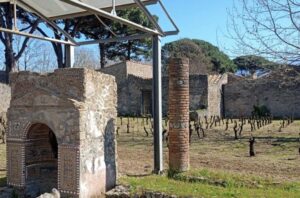
It all began in the 1960s with the curiosity of archaeologist Dr. Wilhelmina Jashemski. She noticed a pattern of small, regularly spaced pits scattered across what appeared to be empty plots within the excavation site. When these cavities were filled with plaster, the results were astonishing: they revealed the root systems of ancient vines.
This discovery proved that Pompeii was not only a center of consumption, but also a place of active production—within city walls and in the gardens of villas.
Sites such as the Villa dei Misteri (Villa of the Mysteries) provided further clarity. Wine presses (torcularia) and large clay storage vessels (dolia) buried underground painted a vivid picture of production at scale. Pompeii was, in its time, a key source of the prestigious Campanian wines that graced the tables of the Roman elite.
The God in the Frescoes: Dionysus and the Spirit of Wine
To understand Pompeii’s wine identity, one must look at the famous frescoes of the Villa dei Misteri. These “megalographies”—large-scale wall paintings—depict mysterious initiation rites held in honor of Dionysus, the god of wine.
In these images, wine is not merely a drink; it is a sacred medium of transformation. The frescoes remain among the most powerful historical testimonies to the cultural and spiritual significance of wine in the ancient world.
The Revival Project: A Collaboration with Mastroberardino
The effort to bring Pompeii’s wine identity back from paper to soil began in 1996. The management of the Pompeii Archaeological Park entered into a strategic partnership with the Mastroberardino family, one of the region’s most established wine producers.
The goal was not simply to create a commercial product, but to establish a living laboratory for “archaeo-enology”—the reconstruction of ancient winemaking practices.
Choosing the Right Grapes
The most critical question was simple, yet profound: which grape varieties were grown here two thousand years ago?
Scientists and oenologists combined paleobotanical remains, ancient pollen analysis, and descriptions from classical authors such as Pliny. DNA studies ultimately led to the selection of three key varieties:
- Piedirosso: Named for its red stems resembling a bird’s foot, this grape is deeply suited to volcanic soils. It contributes softness and vibrant red fruit character.
- Sciascinoso: Morphologically the closest match to grape clusters depicted in ancient frescoes, it was included to enhance body and color in the blend.
- Aglianico: Considered the noble grape of the region, it was chosen for its structure, tannins, and aging potential.
Fidelity to Ancient Techniques
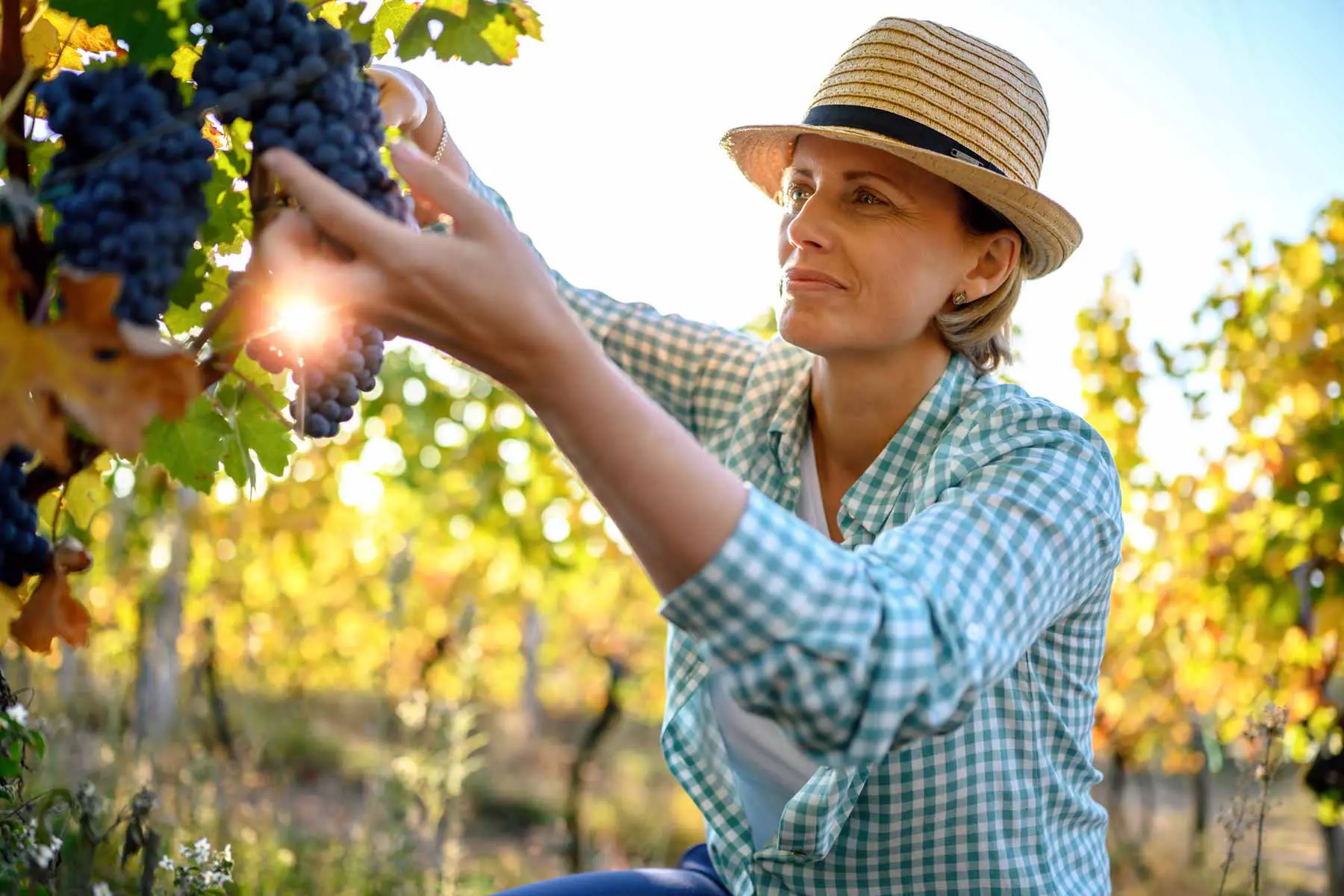
Recreating the vineyards required more than selecting the right grapes; it demanded the right methods. Modern trellising systems are absent in Pompeii’s vineyards today. Instead, vines are trained using chestnut stakes, as described in ancient texts and evidenced in archaeological remains.
Each vine is planted according to historical spacing, and all vineyard work is carried out manually.
This meticulous approach ensures that not only the name, but also the terroir of the wine becomes a historical reconstruction. At harvest time, workers enter the ancient city and pick grapes from the same soils once cultivated by their predecessors two millennia ago.
An Economic and Cultural Cycle: “Villa dei Misteri” Wine
The project has evolved into a compelling model for the preservation of cultural heritage. The wines produced are bottled in very limited quantities under the label “Villa dei Misteri.”
Their journey into the market rests on three key pillars:
- Niche and Prestigious Distribution: The wines are presented in top-tier restaurants and select wine cellars as a tangible “piece of history.”
- Funding Preservation: A significant portion of the revenue is directed back into ongoing excavations and the maintenance of ancient vineyards in Pompeii. In this sense, the wine sustains its own past.
- Experiential Tourism: Visitors to Pompeii today encounter not only ruins, but living vineyards—transforming the site from a “dead city” into a landscape of continuity and cultivation.
A Sip from the Past into the Future
Today, vineyard areas within the Pompeii Archaeological Park exceed six hectares. The ambition now extends beyond cultivation: plans include establishing an on-site winery, completing the entire process as it would have been in antiquity.
The reconstruction of Pompeii’s wine identity reminds us that wine is not merely a fermented beverage. It is the memory of a landscape, an expression of culture, and a testament to resilience. These vines, rising from the ashes of Vesuvius, continue to tell one of the most vivid stories of the ancient world as they fill our glasses once more.
A Final Word—Because It Must Be Said
We cannot bring ourselves to end this piece without adding one final note.
Across Anatolia, nearly every archaeological site bears traces of ancient vineyards and wine culture. The depas cups of Troy, the amphorae of Knidos, the pithoi of Laodicea and Hierapolis—all stand as reminders of this deep-rooted relationship.
And yet, the fact that no serious effort has been made to revive vineyards in at least some of these ancient cities—using the very methods once practiced there—remains, frankly, our collective failure.
This land hosts countless ancient wine installations, the exact number of which we may never fully know. There is little doubt that they were once actively used by the people who lived here. It is not unreasonable to imagine that, were they to see where we stand today in viticulture and winemaking, they might turn in their graves.
Still, let us make the call.
Archaeologists in this country are among the most open-minded and forward-thinking professionals we have. One of the simplest ways to transform ancient cities into living landscapes again is to reintroduce vineyards—even on a small scale.
Let these lands be replanted. Let visitors encounter grapes growing where they once did. And let us all be surprised—and perhaps even a little humbled—by the interest and joy they inspire.